Ask any electrician or smart home installer about the most common compatibility headache they encounter, and the answer is usually the same: dimmer switches and LED bulbs that simply don't get along. The rapid shift away from incandescent and halogen lighting towards dimmable LED lamps has left many homes stuck with dimmers that were never designed for the job. The result is all too familiar — flickering lights, audible buzzing from the switch or the fitting, and bulbs that fail far sooner than they should. Whether you're upgrading an existing property or specifying a new smart home build, choosing the wrong dimmer switch isn't just frustrating; it can be genuinely damaging to your lighting investment.
The good news is that modern smart dimmer switch modules have been designed to solve exactly this problem. These behind-switch devices retrofit into your existing switch boxes without the need to rewire, intelligently detect the type of light source connected, and deliver smooth brightness adjustment from 1–100%. Today's best smart dimmers offer compatibility with incandescent, halogen, and dimmable LED lamps, support for the leading wireless protocols — Z-Wave, Zigbee, and Matter — and built-in energy monitoring that helps you understand and reduce your electricity consumption over time.
This guide covers everything you need to make a confident decision. Across eight sections, you'll learn how dimmer types work at a technical level, how to verify lamp type compatibility before you buy, how to navigate 2-wire and 3-wire wiring configurations, when bypass accessories are necessary, how to match protocol choice to your smart home ecosystem, how to make use of energy monitoring, how to retain your existing switches while gaining smart control, and how protective features like soft-start safeguard your lighting. Technical and practical considerations are both covered in full.
1. Understand the Dimming Technology Behind the Switch: Trailing Edge vs. Leading Edge
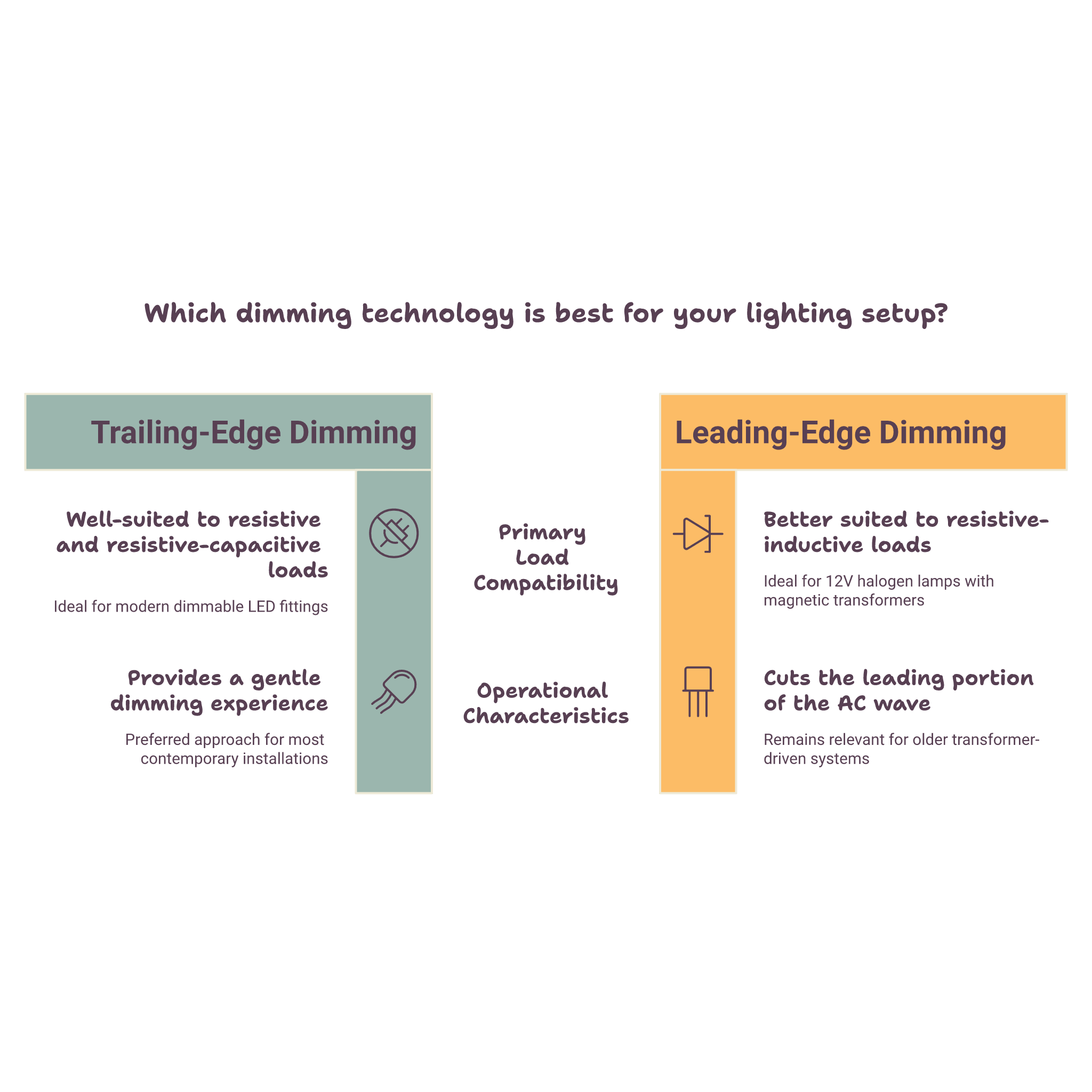
Not all dimmer switches control light the same way. The two main approaches — trailing-edge and leading-edge dimming — describe which part of the AC mains waveform is cut to reduce brightness, and the distinction has a significant impact on which lamp types a dimmer can handle reliably. Understanding this helps explain why an older dimmer designed for incandescent bulbs can cause so many problems when connected to a modern LED fitting.
How each dimming type works:
- Trailing-edge (MOSFET-based): cuts the trailing portion of the AC wave; gentle and well-suited to resistive and resistive-capacitive loads such as dimmable LEDs
- Leading-edge (TRIAC-based): cuts the leading portion of the wave; better suited to resistive-inductive loads such as 12V halogen lamps run through magnetic transformers
- Dual-mode: automatically selects the correct method based on the detected load type
For most contemporary installations, trailing-edge dimming is the preferred approach because LED drivers behave as capacitive loads and respond far more cleanly to it. Leading-edge dimming remains relevant where transformer-driven 12V halogen systems are still in use. The most capable smart dimmer modules today include automatic dimming type selection, detecting the connected load and switching modes accordingly — removing the guesswork entirely and making them genuinely universal dimmer types for mixed installations.
2. Verify Lamp Type Compatibility Before You Buy
Lamp type compatibility is one of the most important factors to check before purchasing any dimmer switch, yet it's frequently overlooked. Not every smart dimmer supports every light source, and assuming compatibility without checking can lead to exactly the flickering and buzzing problems this guide is designed to help you avoid.
Lamp types typically supported by smart dimmer modules:
- Incandescent bulbs (resistive load — widest compatibility)
- 230V halogen lamps (also resistive — generally well-supported)
- 12V halogen via magnetic or electronic transformers (inductive/capacitive — check carefully)
- Dimmable LED lamps (capacitive — requires trailing-edge or auto-detecting dimmer)
- Non-dimmable loads in on/off mode (typically supported in 3-wire configurations only)
Advanced smart dimmers feature intelligent light source detection algorithms that automatically calibrate the module to the connected load during initial setup. This removes the need for manual configuration and makes installation far more straightforward, particularly across mixed lighting environments where incandescent, halogen, and dimmable LED lamps may be used across different circuits in the same property. If your installation includes non-dimmable fittings, some modules can handle these in on/off mode — but this typically requires a 3-wire (neutral) connection, which leads neatly into the next consideration.
3. Choose the Right Wiring Configuration: 2-Wire vs. 3-Wire Installation
For many homeowners and installers working on older UK and European properties, the availability of a neutral wire at the switch position is far from guaranteed. This single factor — whether or not you have a neutral — is often the deciding consideration when selecting a behind-switch dimmer module.
Key differences between wiring configurations:
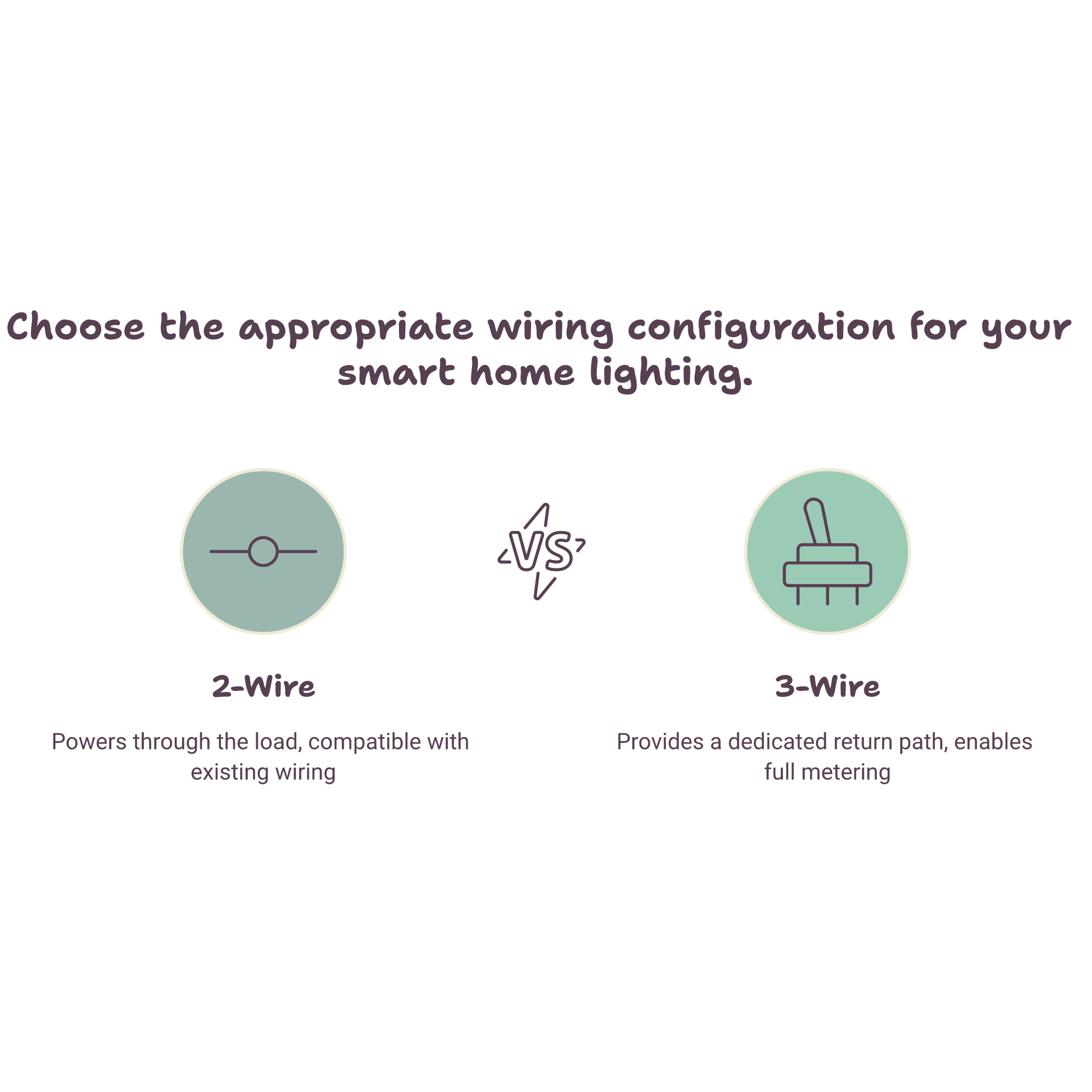
- 2-wire (no neutral): powers the module through the load; compatible with most existing UK switch wiring; limits some metering capabilities
- 3-wire (with neutral): provides a dedicated return path; enables full power and energy metering; supports on/off control of non-dimmable loads
- Behind-switch module format: works with both configurations without replacing existing wiring infrastructure
The behind-switch module approach is one of the most practical innovations in smart home lighting control. Rather than replacing the entire switch plate and rewiring, the module sits inside the existing back-box behind your current switch. This means the visible switch face remains unchanged, and the smart functionality is added invisibly. For retrofit projects — whether in a single room or across an entire property — this approach dramatically reduces installation time and disruption. If neutral wiring is available, opting for a 3-wire installation unlocks the full capability of the dimmer, including comprehensive energy monitoring features covered in Section 6.
4. Factor in Bypass Accessories for Low-Load LED Installations
One of the most commonly overlooked challenges in LED dimmer installations involves very low-load circuits — for example, a single LED bulb or a small cluster of low-wattage LEDs. Smart dimmer modules require a minimum load to operate correctly, and when the connected load falls below that threshold, the result can be instability, flickering, or ghost-switching where the lights appear to turn on by themselves.
When a bypass accessory is needed:
- Single LED bulb installations with very low wattage
- Small LED clusters where total load falls below the dimmer's minimum threshold
- Circuits experiencing flickering or instability despite correct wiring
A bypass accessory resolves this by providing a minimum load path in parallel with the lamp, stabilising the dimmer's operation regardless of how light the connected LED load is. Some smart dimmer modules ship with a bypass accessory included in the box — a genuine convenience that eliminates the need to diagnose and order separately after installation. Others require the bypass to be purchased as an additional accessory. It's worth confirming this at the point of purchase, particularly if you're installing onto LED-only circuits where the total wattage is likely to be low.
5. Evaluate Smart Protocol Compatibility: Z-Wave, Zigbee, and Matter
The wireless protocol built into a smart dimmer switch module determines which hubs, apps, and ecosystems it can work with — and getting this wrong can mean a device that simply won't integrate with the rest of your smart home. The three protocols found across the products covered in this guide each have distinct characteristics worth understanding before you commit.
Z-Wave
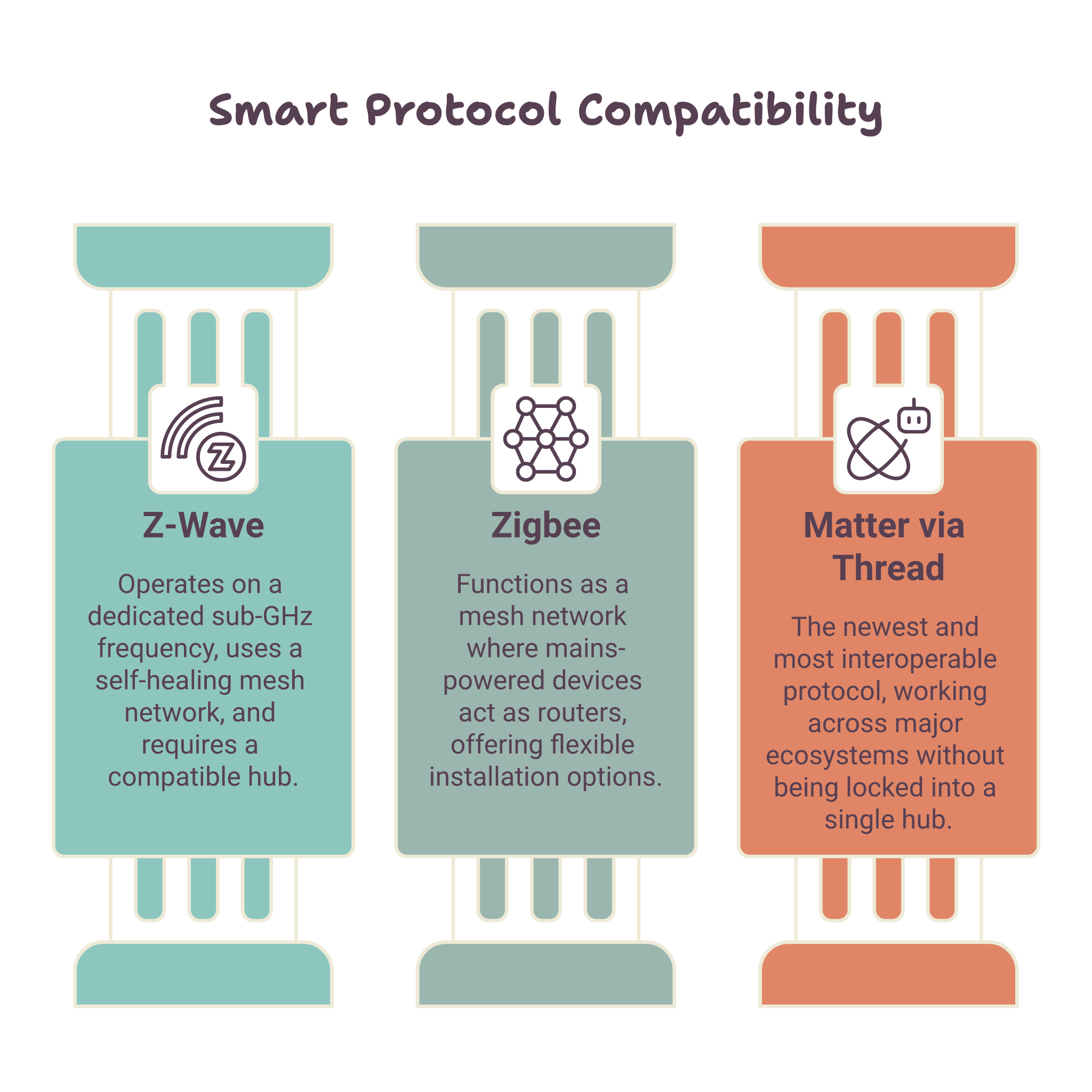
Z-Wave operates on a dedicated sub-GHz frequency (868MHz in Europe), which means it doesn't compete with Wi-Fi or Zigbee for airspace. It uses a self-healing mesh network where each device acts as a repeater, extending range across the property. Z-Wave Plus with S2 security adds improved range, enhanced reliability, and AES-128 encryption for secure pairing. Z-Wave requires a compatible hub such as Hubitat, Home Assistant, or SmartThings, but offers deep integration and broad ecosystem support.
Zigbee
Zigbee also operates as a mesh network — mains-powered devices act as routers, strengthening the network the more devices you add. Most Zigbee dimmers require a hub (such as a Zigbee coordinator on Home Assistant via Zigbee2MQTT, or a SmartThings hub), but some can operate in a standalone mode when paired directly to a compatible remote or wall controller without any hub at all. This makes Zigbee a flexible option for both simple and complex installations.
Matter via Thread
Matter is the newest and most interoperable of the three protocols. Devices using Matter over Thread can work across Apple Home, Google Home, Amazon Alexa, and other Matter-compatible ecosystems without being locked into a single hub. This offers the broadest long-term compatibility, though full feature depth (such as energy monitoring) may depend on hub availability and ecosystem support.
6. Assess Power and Energy Monitoring Capabilities
Built-in energy monitoring is one of the features that genuinely separates a smart dimmer switch from a conventional dimmer. The ability to measure real-time power consumption in watts and track accumulated usage in kilowatt-hours transforms a simple lighting control device into a useful tool for understanding and reducing your electricity usage.
What energy monitoring enables:
- Real-time wattage readings to confirm actual load and dimming efficiency
- kWh tracking for cost calculations and energy-saving comparisons
- Automation triggers — for example, an alert or scene change when a circuit draws unexpected wattage
- Dashboard visualisation as daily, weekly, or yearly consumption charts
It's worth noting that full metering capability — covering power, energy, voltage, and current — typically requires neutral wiring. Modules installed in 2-wire configurations may offer limited or no energy monitoring, depending on the product. Additionally, some monitoring features are only fully accessible within specific smart home platforms, so it's worth confirming ecosystem compatibility if detailed energy data is a priority for your installation.
7. Consider Switch Type Flexibility and Scene Control
One of the most practical advantages of behind-switch smart dimmer modules is that they work with the physical switches you already have. There's no need to replace switch plates or invest in new wall hardware — the module inside the back-box handles the intelligence, and your existing switch simply becomes the input device.
Supported switch types across smart dimmer modules:
- Momentary (push-button) switches
- Toggle (rocker) switches
- 1-way and 2-way switching configurations
- Second switch input for associated device control or multi-location switching
Beyond basic on/off and dimming, many smart dimmer modules support scene management directly from the wall switch. A single press, double press, or long press can be configured to activate a lighting scene — switching multiple lights to a preset brightness and colour temperature simultaneously. Some products go further, offering a physical dial interface that allows direct brightness adjustment and scene activation in one touch point. This kind of switch type flexibility means you can deliver a premium control experience without any structural changes to your existing switch layout.
8. Protect Your Lighting with Soft-Start, Overload, and Power Failure Features
The intelligence built into a modern smart dimmer switch extends well beyond wireless connectivity and brightness control. Protective mechanisms built into quality modules serve both the lamps and the end user — reducing wear, preventing damage, and ensuring predictable behaviour even after unexpected events like power cuts.
Protective features to look for:
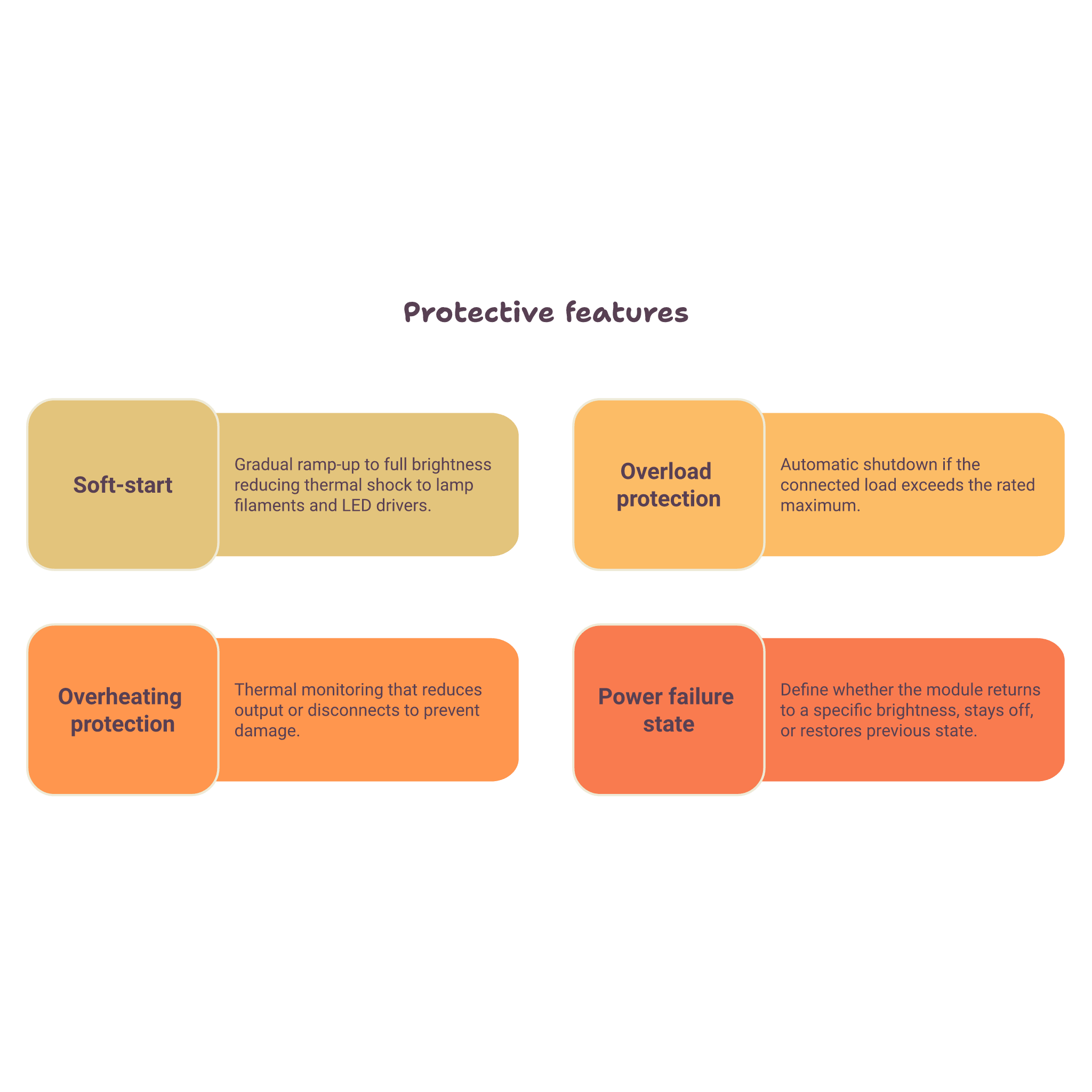
- Soft-start: gradual ramp-up to full brightness rather than instant switching, reducing thermal shock to lamp filaments and LED drivers
- Overload protection: automatic shutdown if the connected load exceeds the rated maximum
- Overheating protection: thermal monitoring that reduces output or disconnects to prevent damage
- Configurable power failure state: define whether the module returns to a specific brightness, stays off, or restores its previous state after a power cut
Soft-start is particularly valuable for lamp longevity. Incandescent and halogen filaments are most vulnerable to failure at the moment of switch-on, when a cold filament draws a surge of current. By ramping up gradually, soft-start reduces this thermal stress and extends lamp life meaningfully. The configurable power failure state is equally important in professional and commercial installations — predictable, defined behaviour after a power cut is a requirement in many environments, and having that control at the module level rather than relying on hub recovery logic is a significant advantage.
Our Recommended Dimmer Switches for Incandescent, Halogen, and LED Lighting Control
The following five smart dimmer modules are available at Vesternet and represent a range of protocols, installation formats, and feature sets. All support behind-switch installation and are compatible with incandescent, halogen, and dimmable LED lighting — but each is best suited to a particular type of user or installation scenario.
Best for Z-Wave Ecosystems with Automatic Load Detection — Vesternet Z-Wave Dimmer
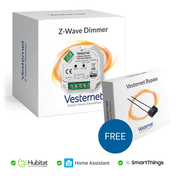
Positioned as an accessible entry point into Z-Wave smart dimming, the Vesternet Z-Wave Dimmer is a well-rounded behind-switch module that handles the most common installation scenarios without fuss. It automatically detects the connected light source and switches between trailing-edge and leading-edge dimming accordingly — making it a reliable choice for mixed incandescent, halogen, and dimmable LED circuits alike. It supports both 2-wire and 3-wire wiring configurations and ships with a bypass accessory included, removing the need for a separate purchase on low-load LED circuits.
Additional features include soft-start lighting, power, energy, voltage, and current metering, support for both momentary and toggle switches, and configurable power failure state behaviour. Z-Wave Plus S2 security ensures reliable, encrypted communication with compatible hubs including Hubitat, Home Assistant, and SmartThings. This module is recommended for Z-Wave users who want a self-calibrating, plug-and-play dimmer switch with broad hub compatibility and no need to source additional accessories.
Best Advanced Z-Wave Dimmer with Scene Control — Fibaro Universal Dimmer 2
The Fibaro Dimmer 2 is the choice for Z-Wave users who want the deepest level of intelligence and control available in a behind-switch format. Its algorithm automatically identifies the connected bulb type and selects the optimal dimming mode — trailing-edge for incandescent, halogen, and LED loads, or leading-edge for transformer-driven inductive systems. This level of automatic calibration makes it genuinely universal across dimmer types and lighting setups.
The Fibaro Dimmer 2 supports 2-wire and 3-wire wiring, a second switch input for 2-way installations or associated device control, scene management via the wall switch, and all four physical switch types: momentary, toggle, 1-way, and 2-way. An integrated RGB indicator assists with installation guidance and status feedback. Note that a Fibaro Dimmer Bypass 2 may be required for loads under 50W — worth factoring in for LED-only circuits. This module is recommended for advanced Z-Wave users, professional installers, and anyone who wants scene management built directly into their lighting control without additional hardware.
Best Z-Wave Dimmer for Compact Retrofit Installations — Nice Dimmer Control
Back-box depth is a real constraint in many older UK properties, where shallow boxes leave little room for additional hardware. The Nice Dimmer Control is a compact Z-Wave Plus module specifically designed with this challenge in mind. Despite its small form factor, it supports 2-wire and 3-wire configurations, intelligent light source detection with automatic calibration, and can be operated via both Z-Wave radio and a directly wired wall switch.
This module is recommended for Z-Wave users in properties with limited back-box depth, and for installers who need a reliable, intelligent dimmer switch module that doesn't compromise on detection capability just because of its size. It's a practical solution for retrofit projects where space is the primary constraint.
Best Zigbee Dimmer for Hub-Optional Flexibility — Vesternet Zigbee Dimmer
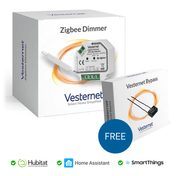
The Vesternet Zigbee Dimmer is the most accessible option in this lineup for users building on the Zigbee protocol, offering wiring flexibility and a notable standalone capability. It supports both 2-wire and 3-wire configurations, trailing-edge dimming for maximum LED compatibility, soft-start, and full power, energy, voltage, and current metering. Like the Vesternet Z-Wave module, it ships with a bypass accessory included — a practical inclusion for low-load dimmable LED installations.
What sets this module apart is its ability to pair directly with a compatible remote control or wall controller without requiring a hub — making it an excellent starting point for installations that may be expanded into a full smart home ecosystem later. It's fully compatible with Hubitat, Home Assistant via Zigbee2MQTT, and SmartThings. Recommended for Zigbee users who want a flexible, budget-accessible dimmer switch with all the essentials covered from the outset.
Best for Multi-Protocol and Wall-Mounted Control — Aqara Dimmer Switch H2
The Aqara H2 takes a different approach from the rest of this lineup. Rather than a hidden behind-switch module, it's a wall-mounted dimmer switch with a precision dial interface that delivers smooth 1–100% brightness adjustment, on/off control, and scene activation from a single, tactile control point. The dial experience is premium — immediate and intuitive in a way that app-based dimming rarely achieves on its own.
Protocol flexibility is another standout quality. The H2 supports both Zigbee — with full functionality via an Aqara hub, including energy monitoring and scene control — and Thread/Matter for hub-free use in Matter ecosystems. It's compatible with incandescent, halogen, dimmable LED, and CFL lamps, and supports both leading-edge and trailing-edge dimming. Power-off memory ensures the light returns to the correct state after a power cut. This device is recommended for users who want a visible, premium-feel wall switch rather than a hidden module, those building on Matter or Thread ecosystems, and Aqara hub users wanting a single device that handles energy monitoring and scene control together.
Conclusion
Choosing the right smart dimmer switch comes down to understanding six core factors: the dimming technology (trailing-edge versus leading-edge and whether the module selects automatically), the lamp types in use across your circuits, your wiring configuration (2-wire or 3-wire), the wireless protocol that fits your existing or planned smart home ecosystem, whether bypass accessories are needed for low-load LED circuits, and the additional intelligence layers — soft-start, energy monitoring, scene control, and configurable power failure recovery — that separate a genuinely smart lighting solution from a basic dimmer with a wireless radio bolted on. The products covered in this guide demonstrate that modern smart dimmers are truly versatile tools, capable of handling incandescent, halogen, and dimmable LED loads intelligently with minimal disruption to existing wiring.
The best next step is to audit your property before purchasing. Identify the lamp types in use, check whether neutral wiring is available at each switch position, and confirm which smart home platform or hub your installation is built around. From there, match your requirements to the appropriate protocol — Z-Wave, Zigbee, or Matter — decide whether a behind-switch module or a wall-mounted switch replacement better suits your needs, and check the minimum load specifications for any LED-only circuits where a bypass may be required. Most modules in this category are designed for straightforward DIY retrofitting into existing back-boxes, making the installation process far less daunting than it might initially appear.
Ready to take the next step? Browse Vesternet's full range of smart dimmer switches and wall controller dimmers at vesternet.com/collections/dimmers and vesternet.com/collections/wall-controller-dimmers, where you'll find the complete product lineup alongside compatibility guides, wiring diagrams, and installation resources. If you're unsure which dimmer is right for your specific setup, Vesternet's expert team is on hand to help — reach out via live chat or email for personalised advice tailored to your lighting circuit and smart home ecosystem.