Smart lighting upgrades are one of the most popular entry points into home automation — but the choice of wireless protocol can make or break the experience. Whether it's poor range, compatibility headaches, or limited integration with your existing smart home platform, picking the wrong dimmer switch creates problems that are frustrating to unpick after installation. With Zigbee and Matter over Wi-Fi both offering genuinely compelling capabilities, the decision deserves more than a quick glance at a spec sheet.
This guide puts two Sonoff dimmer switches head-to-head: the Zigbee Sonoff Mini Extreme Dimmer and the Matter Sonoff MINI Extreme Dimmer Switch. We'll walk through how each one works, where each excels, and which suits different homes and lifestyles — so by the end, you'll know exactly which to choose and why.
Vesternet has spent years supplying and supporting smart home technology across the UK, specialising in Zigbee, Z-Wave, and Matter devices. We understand what these products deliver in real homes — not just on paper — which puts us in a strong position to guide this comparison fairly and practically.

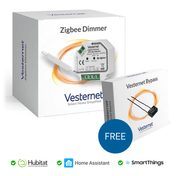
Inside the Zigbee Sonoff Mini Extreme Dimmer: Mesh Networking Meets Retrofit Smart Lighting
The Zigbee Sonoff Mini Extreme Dimmer is a compact in-wall dimmer designed to bring intelligent lighting control to existing circuits without major rewiring. It uses trailing-edge dimming technology to deliver smooth, flicker-free brightness control — particularly well-suited to modern LED lamps, though it also supports incandescent and halogen loads. With a load rating of up to 200VA for dimmable LEDs, 400W for incandescent and halogen, and 200W for dimmable electronic transformers, it covers a wide range of residential lighting setups.
What sets this dimmer apart within a smart home network is its role as a Zigbee 3.0 router. Rather than simply consuming network traffic, it actively extends mesh coverage — reducing dead zones and strengthening connections across the home. It also supports dual-location switch control using either momentary or rocker switches, making it a practical fit for staircases, hallways, or any room where two-switch operation is needed. Integration with Home Assistant is built in, and its Matter certification means it can slot into broader Matter-certified ecosystems for automations and voice control.
Key Features at a Glance
- Trailing-edge, flicker-free dimming for LED, incandescent, and halogen
- Zigbee 3.0 router functionality to extend mesh network coverage
- Dual switch location support via momentary or rocker switches
- Real-time power monitoring and overheat protection
- Compatible with Home Assistant and Matter-certified ecosystems

Inside the Matter Sonoff MINI Extreme Dimmer Switch: Universal Smart Home Control over Wi-Fi
The Matter Sonoff MINI Extreme Dimmer Switch takes a different approach, connecting directly to your home Wi-Fi network using the Matter protocol. It's designed to upgrade traditional lighting circuits into a smart system with smooth, flicker-free dimming — again using trailing-edge technology — and supports LED loads up to 200VA and incandescent loads up to 400W. One of its standout features is automatic and manual dimming calibration, which allows the dimmer to adapt to the specific characteristics of different lamp types for more stable, consistent performance.
Where this dimmer truly shines is in its ecosystem reach. It integrates natively with Apple Home, Google Home, and Amazon Alexa via Matter, enabling voice control and automation through whichever platform you already use. It's worth noting that a Matter Hub is required to bring it into these ecosystems fully. Alongside that broad compatibility, it includes real-time energy monitoring and overheat protection — all packed into an ultra-compact design that suits retrofit installations. It supports two-switch control and requires a 3-wire neutral connection.
Key Features at a Glance
- Matter over Wi-Fi for native Apple Home, Google Home, and Alexa integration
- Automatic and manual dimming calibration for optimised lamp performance
- Trailing-edge, flicker-free dimming for LED and incandescent loads
- Real-time energy monitoring and overheat protection
- Ultra-compact design with two-switch control support
Zigbee Mesh vs Matter over Wi-Fi: How Your Protocol Choice Shapes Your Entire Smart Lighting Setup
The most fundamental difference between these two dimmers is the wireless protocol they use — and that choice ripples outward to affect everything from network behaviour to ecosystem compatibility and daily usability.
Protocol Architecture and Network Behaviour
The Zigbee Sonoff Mini Extreme Dimmer operates on Zigbee 3.0, a mesh networking protocol where devices communicate with each other as well as with a central coordinator. Its role as a Zigbee 3.0 router is a meaningful advantage: every unit you install actively extends the network, helping signals reach further and reducing the dead zones that can plague wireless smart home setups in larger or multi-storey homes. The Matter Sonoff MINI Extreme Dimmer Switch, by contrast, runs over Wi-Fi using the Matter protocol. It relies on your existing router infrastructure rather than forming its own mesh, which means performance is tied to the strength and reliability of your Wi-Fi signal in that part of the home.
Hub Requirements and Ecosystem Compatibility
Both dimmers require some form of hub, but the nature of that requirement differs. The Zigbee model needs a Zigbee hub or coordinator — such as a Home Assistant-compatible controller — to function within your smart home. The Matter model requires a Matter Hub to integrate fully with Apple Home, Google Home, or Amazon Alexa. However, once connected, the Matter model unlocks genuinely seamless native integration with all three major ecosystems without any additional Zigbee coordination layer. Users already running a Zigbee network will find the Zigbee dimmer slots in naturally, while those embedded in Apple, Google, or Amazon ecosystems will find the Matter model far more straightforward.
Switch Input Flexibility and Calibration
- The Zigbee model supports both momentary and rocker switch types for dual-location control
- The Matter model supports a single switch input, limiting two-location flexibility
- The Matter model offers automatic calibration; the Zigbee model does not
- The Zigbee model supports electronic transformer loads up to 200W; the Matter model's specifications do not list this
These distinctions matter practically. If your home has a hallway or staircase light requiring two-switch operation using rocker switches, the Zigbee model's flexible switch input support makes it the more suitable fit. On the other hand, the Matter model's automatic calibration can be genuinely useful when working with a variety of LED lamps that each behave slightly differently across their dimming range.

Dimming Smoothness, Network Reliability, and Day-to-Day Responsiveness: A Real-World Performance Breakdown
Both dimmers use trailing-edge dimming technology, which is widely regarded as the preferred method for modern LED lamps. Unlike leading-edge dimming, trailing-edge control produces smoother transitions and reduces the flicker and buzz that can plague poorly matched dimmers and LED drivers. With LED load ratings of up to 200VA on both models, the practical performance for most residential lighting circuits should be comparable — assuming compatible lamps are used.
Where the Protocols Diverge in Practice
Network reliability tells a different story depending on your home's setup. The Zigbee Sonoff Mini Extreme Dimmer benefits from Zigbee 3.0's mesh architecture — meaning that in a home already running several Zigbee devices, each additional router node (including this dimmer) strengthens the overall network. This makes it particularly well-suited to larger floorplans or multi-storey homes where signal consistency matters. The Matter Sonoff MINI Extreme Dimmer Switch depends on Wi-Fi signal quality, so in areas of the home where router coverage is weaker, responsiveness may be less consistent.
Calibration, Energy Monitoring, and Protection
- The Matter model's automatic calibration adapts the dimming range to individual lamp behaviour
- Both models include real-time energy monitoring for tracking consumption
- Both include overheat protection to guard against thermal issues
- Both require a 3-wire neutral connection for installation
The Matter model's automatic calibration is a real practical benefit for anyone switching between lamp types or installing across multiple rooms with varied LED fittings. It reduces the manual adjustment needed to achieve stable, smooth dimming across different loads. Both models handle scheduling reliably through their respective platforms, and the shared inclusion of energy monitoring and overheat protection means neither compromises on safety or insight regardless of which protocol you choose.
What the Zigbee Sonoff Mini Extreme Dimmer Gets Right — and Where It Falls Short
The Zigbee Sonoff Mini Extreme Dimmer brings a strong combination of network capability and installation flexibility. Its role as a Zigbee 3.0 router means it's not just a dimmer — it's an active contributor to your mesh network, improving coverage every time you add one. Compatibility with Home Assistant makes it an excellent choice for users who prefer local control and open-source automation, while its Matter certification means it can also participate in broader Matter-certified setups. The support for both momentary and rocker switches at two locations adds genuine installation flexibility for multi-switch rooms.
Pros
- Zigbee 3.0 router functionality extends mesh network coverage
- Dual-location control with both momentary and rocker switch support
- Wide load compatibility including electronic transformers up to 200W
- Home Assistant compatible with scene and schedule automation
Trade-offs to Consider
The Zigbee model does require a Zigbee hub or coordinator, which adds a step for anyone starting from scratch without an existing Zigbee network. It also lacks automatic calibration, meaning some manual setup effort may be needed to find the optimal dimming range for certain LED lamp types. For users already running a Zigbee hub and Home Assistant, these are minor considerations — but for someone with no existing Zigbee infrastructure, the initial setup investment is worth factoring in before committing.
What the Matter Sonoff MINI Extreme Dimmer Switch Gets Right — and Where It Falls Short
The Matter Sonoff MINI Extreme Dimmer Switch is a strong choice for anyone already invested in the Apple, Google, or Amazon ecosystems. Its native Matter over Wi-Fi support means it integrates directly with Apple Home, Google Home, and Amazon Alexa without needing a dedicated Zigbee hub or coordinator. The automatic and manual calibration feature is a genuine advantage — it allows the dimmer to intelligently adapt its dimming range to different lamp types, reducing the trial-and-error that can frustrate manual setup. Real-time energy monitoring and overheat protection round out a solid feature set in an ultra-compact form factor.
Pros
- Native Matter over Wi-Fi with Apple Home, Google Home, and Alexa support
- Automatic and manual dimming calibration for varied lamp types
- Real-time energy monitoring and overheat protection included
- Ultra-compact design well-suited to retrofit installations
Trade-offs to Consider
Despite connecting over Wi-Fi, the Matter Sonoff MINI Extreme Dimmer Switch still requires a Matter Hub for full ecosystem integration — so it isn't entirely hub-free. It supports only a single switch input, which limits its usefulness in two-location switch setups compared to the Zigbee model's dual-location flexibility. The specifications also do not list support for electronic transformer loads, which narrows its compatibility slightly for certain installation scenarios. Its reliance on Wi-Fi infrastructure also means that in areas of the home with weaker router coverage, performance may be less consistent.
Finding Your Perfect Match: Which Smart Dimmer Is Built for Your Home and Lifestyle?
Choosing between these two dimmers comes down to understanding your existing setup, your preferred ecosystem, and how you want your smart lighting network to behave. Both are well-built products — but they're built for different types of smart home users.
Choose the Zigbee Sonoff Mini Extreme Dimmer If You:
- Already run a Zigbee network or use Home Assistant for local smart home control
- Need dual-location switch control using rocker or momentary switches
- Want each dimmer to actively extend your Zigbee mesh network coverage
- Are installing in larger homes where mesh reliability matters more than Wi-Fi range
This dimmer is a particularly strong fit for smart home enthusiasts and installers who treat every new device as a network asset. Because it acts as a Zigbee 3.0 router, it helps eliminate dead zones across larger or multi-storey floorplans — a benefit that compounds with each additional Zigbee device installed. It's also the right call for anyone wiring up a staircase or hallway where two switch locations are required, or where the load includes dimmable electronic transformers. Users asking questions around hue dimmer Home Assistant integration will find the Zigbee model's broad Home Assistant compatibility a natural fit for that kind of setup.
Choose the Matter Sonoff MINI Extreme Dimmer Switch If You:
- Are deeply embedded in the Apple, Google, or Amazon smart home ecosystem
- Want plug-and-play Matter integration without Zigbee coordination overhead
- Value automatic dimming calibration for a wider range of LED lamps
- Prefer a straightforward Wi-Fi-based setup with familiar platform controls
For homeowners or renters who already use Apple Home, Google Home, or Amazon Alexa as their primary smart home interface, the Matter model offers the most direct path to integration. Automatic calibration makes it especially approachable for those who don't want to manually optimise dimming ranges for each lamp — it handles that adjustment itself. While it's not the right tool for building out a Zigbee mesh or supporting dual rocker switch setups, it delivers a clean, reliable smart dimming experience within Wi-Fi-based Matter ecosystems. Those researching zooz z wave switches or the best zigbee led strip options will find it useful to compare the protocol approaches here before settling on a platform direction for their wider setup.

So, Which Sonoff Dimmer Should You Choose? Our Final Thoughts
Both dimmers share a strong foundation: trailing-edge flicker-free dimming, overheat protection, real-time energy monitoring, a compact design, and a 3-wire neutral wiring requirement. These shared qualities mean that whichever you choose, you're getting a capable, safety-conscious smart dimmer suited to retrofit installations. The differences, however, are meaningful — and they sit precisely in the areas that matter most to different users: protocol, ecosystem compatibility, hub requirements, switch flexibility, and calibration.
The Zigbee Sonoff Mini Extreme Dimmer is the stronger choice for users who want mesh network expansion, dual-location switch control with rocker or momentary switches, Home Assistant integration, and support for electronic transformer loads. The Matter Sonoff MINI Extreme Dimmer Switch wins for those who want native Apple Home, Google Home, or Alexa integration with automatic calibration and a straightforward Wi-Fi setup. Whether you've been comparing z wave led dimmer options or exploring the best zigbee led strip setups for your network, understanding how each protocol behaves in practice is the key to making a confident decision.
Whichever direction suits your home, both products are available to explore at Vesternet. Take a closer look at the Zigbee Sonoff Mini Extreme Dimmer and the Matter Sonoff MINI Extreme Dimmer Switch — check out the full specifications for each and find the one that fits your lighting setup, your ecosystem, and the way you want your smart home to work.