Most people assume that making everyday appliances smarter — garage doors, boilers, heating systems, or even access control panels — means ripping out existing equipment and starting from scratch. In reality, that couldn't be further from the truth. Hidden smart switches, often referred to as smart relay switches or smart implants, have become one of the fastest-growing categories in home automation precisely because they sit invisibly behind the scenes. They retrofit non-smart devices into a connected home without disturbing the existing setup. Dry contact switches in particular solve a very practical installation challenge: controlling devices without introducing voltage into the switching circuit itself, making them safer and far more versatile across a wide range of applications.
This comparison focuses on two compelling but philosophically different solutions — the Z-Wave Fibaro Smart Implant and the Matter Sonoff MINI Floating Contact Smart Switch. Both can handle tasks like smart garage door control and heating integration, but the way they go about it differs considerably. This article will walk through compatibility, setup experience, integration depth, and everyday performance to help you find the right fit for your smart home setup.
Vesternet has been supplying and supporting smart home technology in the UK for over a decade. As an authorised retailer of both Z-Wave and Matter-based devices, the guidance here comes from hands-on technical knowledge rather than marketing copy. Whether you're a seasoned installer or just beginning your smart home journey, this comparison is designed to give you a clear, honest picture of both products.

Inside the Fibaro Smart Implant: A Hidden Powerhouse for Z-Wave Homes
The Fibaro Smart Implant is a compact retrofit module designed to bring non-smart devices into the FIBARO Z-Wave ecosystem without replacing or disrupting them. It hides inside existing equipment — behind a wall switch, inside a boiler controller, or within a garage door unit — and acts as an intelligent bridge between your Z-Wave network and whatever device it's connected to. One of its most practical features is its dual output channels, meaning it can control two separate circuits from a single unit. That makes it genuinely useful in scenarios where one module needs to do double duty.
Key Technical Highlights
- Powered by safe low-voltage DC between 9V and 30V, with built-in reverse polarity protection
- Two dry contact output channels for independent device control
- Binary and temperature sensor inputs for environmental monitoring
- SmartStart provisioning for simplified Z-Wave network inclusion
- S2 security framework for encrypted Z-Wave communication
Real-world applications are broad. Connecting it to a garage door controller turns an ordinary door into a smart garage door opener — controllable remotely without replacing the existing mechanism. Placing it inside a furnace or underfloor heating controller brings intelligent scheduling and remote access to your heating system. Even a standard wall switch can be transformed into a scene activator, triggering lighting, blinds, and entertainment systems in a single press. For a Fibaro no neutral installation scenario, the module's DC power supply flexibility is a genuine advantage when working within systems that lack a neutral wire at the switch.

Inside the Sonoff MINI Floating Contact Switch: Matter-Ready Control Without a Hub
The Matter Sonoff MINI Floating Contact Smart Switch is a compact dry contact switch built for modern, platform-agnostic smart homes. Its core function is a potential-free (voltage-free) output, which means the device's power supply is completely isolated from the circuit it controls. This electrical isolation is a significant safety advantage — particularly when connecting to sensitive equipment like boilers, solenoid valves, or access systems where introducing voltage could cause damage or interference. The output is configurable as either Normally Open (NO) or Normally Closed (NC), giving you flexibility depending on how the connected device expects to receive its trigger signal.
Standout Features at a Glance
- Matter over Wi-Fi technology for hub-free, cross-platform compatibility
- Accepts AC input (100–240V) and DC input (12–48V) for wiring flexibility
- NO/NC switchable dry contact output
- Optimised for DC low-power applications including solenoid valves and small motors up to 8W
- Native eWeLink app support with voice control capability
For anyone looking for a sonoff basic garage door opener alternative with modern Matter support, the MINI Floating Contact Switch delivers exactly that — smart garage door control via smartphone, with no dedicated hub required. Because it connects directly to Amazon Alexa, Google Home, and Apple Home through Matter, the barrier to entry is remarkably low. Beginners will find the hub-free setup especially accessible, and the eWeLink app provides a straightforward interface for those who prefer app-based control over a full smart home platform.
Protocol, Power, and Compatibility: How These Two Switches Differ Where It Counts
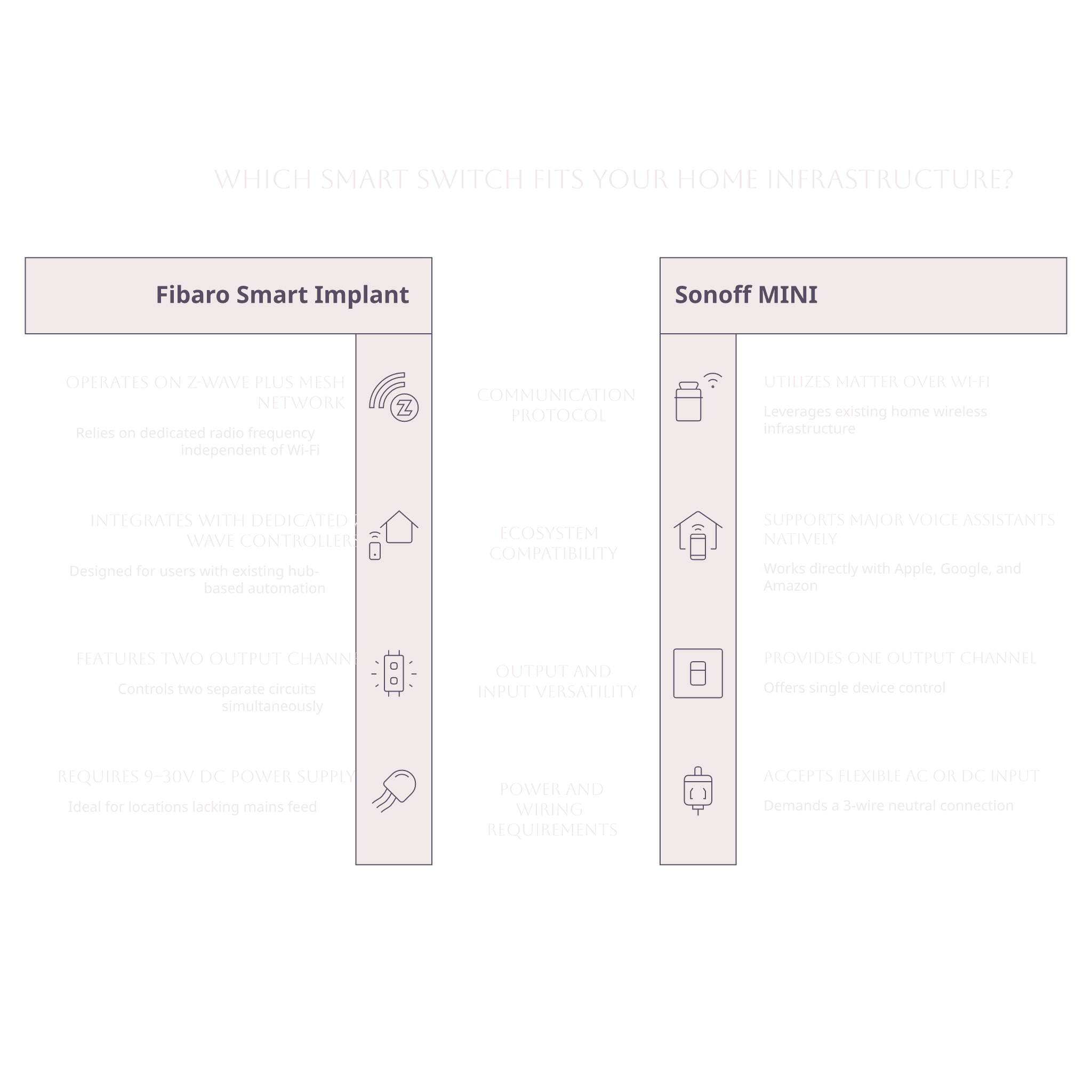
At the heart of the difference between these two devices is the communication protocol they use. The Fibaro Smart Implant runs on Z-Wave Plus, a dedicated home automation radio frequency that operates independently from your Wi-Fi network. Z-Wave forms a mesh network — every powered Z-Wave device in your home helps relay signals to others, improving range and resilience the more devices you add. The Sonoff MINI Floating Contact Switch uses Matter over Wi-Fi, which leverages your existing home Wi-Fi infrastructure. Matter's great strength is interoperability: it's a universal standard backed by Apple, Google, Amazon, and others, meaning the Sonoff will work natively across all three major smart home platforms without any translation layer.
Ecosystem Compatibility Compared
- Fibaro Smart Implant: Fibaro HC2/HC3, Hubitat, HomeSeer, Samsung SmartThings, Vera, Athom Homey
- Sonoff MINI: Amazon Alexa, Google Home, and Apple Home natively via Matter
- Sonoff also supports the eWeLink app independently, with no hub required
These compatibility profiles serve very different audiences. The Fibaro suits users already invested in a Z-Wave controller, where deep automation logic and scene management are handled by the hub. The Sonoff suits users who want immediate, straightforward integration with the voice assistants and platforms they already use daily. Neither approach is inherently superior — it depends entirely on what your home already runs.
Output Channels and Switch Input Types
One of the most practically significant differences is channel count. The Fibaro Smart Implant provides two output channels, allowing a single module to control two separate devices or circuits simultaneously — useful when automating a garage door and a gate latch from the same controller, for example. The Sonoff MINI offers one output channel and one switch input. Both devices support Momentary switch inputs; the Fibaro additionally supports Toggle switches, while the Sonoff supports Rocker-type inputs instead.
Power Input and Wiring Requirements
- Fibaro: DC-only power supply, 9–30V range, with reverse polarity protection
- Sonoff: Flexible AC (100–240V) or DC (12–48V) power input
- Sonoff requires a 3-wire connection including a neutral wire
- Fibaro's low-voltage DC supply suits installations without a mains feed nearby
The Sonoff's neutral wire requirement is worth noting early in your planning. Many older UK switch boxes were wired without a neutral at the switch position. If your installation location lacks a neutral wire, the Sonoff MINI cannot be installed there without additional rewiring. The Fibaro Smart Implant, powered by low-voltage DC from 9V to 30V, sidesteps this issue entirely — it's one reason the Fibaro no neutral scenario is so commonly addressed with this device. The Sonoff's AC/DC flexibility, on the other hand, makes it adaptable to a wider range of power environments once the neutral is available, and its broader voltage range accommodates international installations with ease.
Speed, Responsiveness, and Real-World Reliability: Putting Both Switches to the Test
In everyday smart home use, signal reliability is often more important than features on a spec sheet. Z-Wave's mesh networking gives the Fibaro Smart Implant a meaningful advantage in larger homes or properties with thick walls. Because each Z-Wave device in your network acts as a repeater, signals find their route even when a direct path isn't available. The Sonoff MINI's performance, by contrast, is tied to the strength and consistency of your Wi-Fi network. In a home with solid Wi-Fi coverage, it performs very well — but in a garage, outbuilding, or basement where the router signal is weak, you may notice the occasional delay or dropout. A Wi-Fi extender or mesh network can resolve this, but it adds a step that Z-Wave users don't need to worry about.
Time-Sensitive Applications
- Garage door control: Both devices respond quickly under good network conditions
- Heating triggers: Both are suitable, though Z-Wave mesh offers more consistent reliability
- Scene activation: Fibaro integrates deeply with FIBARO hub logic; Sonoff triggers via Matter automation
For automation scenes, the differences become more apparent. The Fibaro Smart Implant works within the FIBARO ecosystem's logic engine, enabling complex, conditional scenes that involve heating, lighting, security, and binary sensors all acting together. The Sonoff MINI handles cross-platform Matter automation well — pairing naturally with routines in Alexa, Google Home, or Apple Home. Voice control works reliably on both, though the Sonoff's Matter integration means it responds to voice commands across all three major assistants without any additional configuration. Manual switch interaction is supported by both, with the Fibaro accepting both Momentary and Toggle switch types, and the Sonoff supporting Momentary and Rocker inputs, covering the most common switch styles found in UK homes.
Fibaro Smart Implant: Where It Shines and Where It Falls Short
The Fibaro Smart Implant earns its reputation as a hidden powerhouse through a combination of features that few devices in its class can match. Its dual output channels mean one module can control two circuits independently — a genuine time and cost saver in complex installations. The S2 security encryption ensures Z-Wave communication is protected against interception, which matters increasingly as smart home devices become more integrated with security systems. SmartStart provisioning simplifies the pairing process, and support for both binary and temperature sensor inputs means the implant can do more than just switch — it can also report environmental data back to the hub.
Pros
- Dual output channels for controlling two devices from one module
- Extensive Z-Wave hub compatibility across a wide range of controllers
- S2 security encryption and SmartStart provisioning
- Supports binary and temperature sensor inputs
- Wide DC voltage tolerance (9–30V) with reverse polarity protection
Cons
- Requires a Z-Wave hub — no standalone app control without a controller
- Steeper learning curve for non-technical users
- Installation requires confidence with low-voltage DC wiring
- Not suited to those outside the Z-Wave ecosystem
The most significant limitation is its hub dependency. Without a compatible Z-Wave controller in place, the Fibaro Smart Implant cannot function independently. For users new to smart home technology who don't already own a Z-Wave hub, this represents an additional investment and setup step. The device is also most rewarding when paired with a capable hub that can fully exploit its scene activation and sensor input features — which means the learning curve is steeper than plug-and-play alternatives.
Sonoff MINI Floating Contact Switch: Where It Excels and Where It Has Limits
The Sonoff MINI Floating Contact Switch's biggest strength is accessibility. Its Matter over Wi-Fi technology means it works straight out of the box with Amazon Alexa, Google Home, and Apple Home — no hub purchase required. For someone building a smart home around voice assistants or existing Matter devices, it integrates immediately and intuitively. The eWeLink app provides an independent control layer for those who prefer app-based management, and voice control is supported natively. Its flexible AC (100–240V) and DC (12–48V) power input makes it adaptable to a wider range of installation environments than most comparable devices.
Pros
- Hub-free Matter setup with native Alexa, Google Home, and Apple Home support
- NO/NC switchable dry contact output for flexible device compatibility
- AC and DC power input flexibility across a broad voltage range
- Optimised for DC motor and solenoid valve control up to 8W
- eWeLink app control and voice command support included
Cons
- Single output channel — cannot control two circuits from one device
- Requires a 3-wire installation with a neutral wire present
- Performance depends on stable Wi-Fi coverage at the installation point
- Operating temperature limited to -10°C to 40°C
- DC motor load capped at 8W, which may not suit higher-draw applications
The 8W DC motor load cap is worth considering carefully. For controlling solenoid valves and small motors in low-power DC applications, it performs well and reliably. However, if your use case involves a higher-draw device, you would need to route control through an external contactor — a feature the device does support, but one that adds complexity to the installation. The single output channel is also a meaningful constraint for anyone hoping to manage two devices from a single module, as the Fibaro can do.
Finding Your Perfect Match: Which Switch Suits Your Smart Home Setup?
Translating technical specifications into a real-world recommendation means thinking about your existing setup, your comfort with installation, and what you actually need the switch to do. The Fibaro Smart Implant is the natural choice for anyone already running a Z-Wave ecosystem. Its dual output channels, deep scene integration, and extensive hub compatibility — spanning Fibaro HC2/HC3, Hubitat, HomeSeer, SmartThings, Vera, and Athom Homey — make it a powerful tool for professional installers and experienced DIY enthusiasts managing complex, multi-device environments. If you need a smart relay switch that can handle garage door control and heating integration simultaneously from a single module, or one that feeds temperature data back into your automation logic, the Fibaro is hard to beat.
Choose the Fibaro Smart Implant If You:
- Already own or plan to install a compatible Z-Wave hub
- Need dual-channel control from a single hidden module
- Want deep scene automation across heating, lighting, and security
- Require binary or temperature sensor input alongside switching
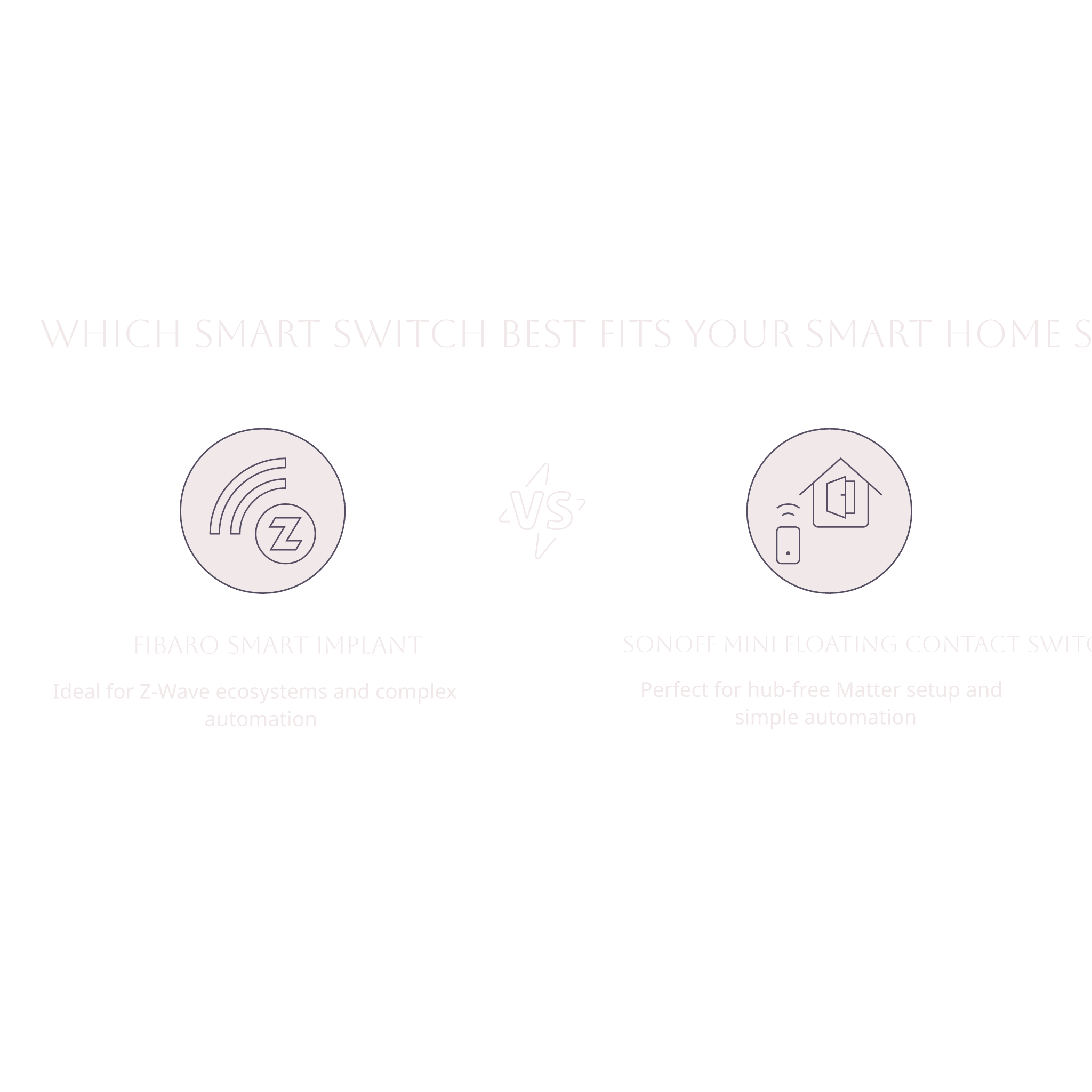
The Sonoff MINI Floating Contact Switch suits a different but equally valid profile. For beginners, renters, or anyone building a smart home around the major voice assistant platforms, its hub-free Matter setup removes the single biggest barrier to entry. It's an ideal solution for those looking for a straightforward smart garage door opener upgrade, boiler control, or solenoid valve automation without the overhead of a hub. Its NO/NC switchable output and broad AC/DC power input flexibility also make it genuinely versatile for a range of dry contact applications.
Choose the Sonoff MINI If You:
- Want a hub-free setup using Amazon Alexa, Google Home, or Apple Home
- Are new to home automation and want a low-barrier entry point
- Need to control a solenoid valve, small motor, or similar low-power DC device
- Have a neutral wire available at the installation point
In mixed-use households, both devices can co-exist without conflict. A Z-Wave Fibaro Smart Implant managing the heating and garage door within a FIBARO hub environment can sit perfectly alongside a Sonoff MINI handling a garden irrigation solenoid valve via Apple Home — each doing what it does best, within the ecosystem it was designed for. The two products aren't rivals so much as different tools for different jobs within the broader smart home relay switch landscape.
Fibaro Smart Implant vs Sonoff MINI Floating Contact Switch: The Final Verdict
Both the Fibaro Smart Implant and the Sonoff MINI Floating Contact Switch are well-designed, capable devices — but they serve meaningfully different smart home philosophies. The Fibaro offers dual output channels, extensive Z-Wave hub compatibility, S2 security, SmartStart provisioning, and sensor input support, all wrapped up in a module that requires a hub but rewards that investment with deep, reliable automation. The Sonoff delivers hub-free Matter simplicity, flexible AC/DC power input, NO/NC dry contact output, and native cross-platform voice control, with a lower barrier to entry and a broader accessibility profile.
Neither product is objectively better. The right choice depends entirely on what you already have, what you're comfortable installing, and what you need the switch to do day to day. If Z-Wave is your ecosystem and complexity is your comfort zone, the Fibaro Smart Implant is a remarkably capable hidden tool. If you want to add smart garage door or boiler control quickly and easily without a hub, the Sonoff MINI Floating Contact Switch is a strong, future-proof choice built on the Matter standard.
If you're still weighing up the options, explore the Fibaro Smart Implant and the Sonoff MINI Floating Contact Switch on the Vesternet website to see the full specifications and find the right fit for your home. Both are stocked and supported by Vesternet's team, so you'll find further guides and advice to help you get the most from whichever direction you choose.