Smart home enthusiasts often struggle to choose the right wall controller configuration, with too few buttons limiting automation potential while too many can create complexity and confusion for daily use. The balance between comprehensive home control capabilities and user-friendly operation becomes particularly challenging when selecting between multi-button configurations for your home automation solutions.
This comprehensive comparison will help you decide whether the 8-button or 4-button Vesternet Zigbee Wall Controller better suits your smart home needs, examining automation capacity, usability, and integration capabilities. We'll explore how each model performs with popular platforms like SmartThings, analysing their real-world applications and long-term scalability potential.
As specialists in Zigbee smart home technology, Vesternet's engineering team has extensively tested both controllers across multiple hub platforms, ensuring our recommendations are based on real-world performance and customer feedback. Our commitment to transparent, practical guidance helps you make informed decisions about your smart home infrastructure.

Understanding the 8-Button Powerhouse
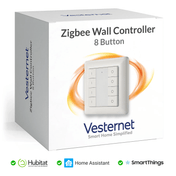
The Vesternet Zigbee Wall Controller with 8 buttons represents the pinnacle of home control versatility, offering an impressive 24 unique event triggers through its pushed, held, and released functions for each button. This extensive capability transforms a single wall-mounted device into a comprehensive command centre for your entire home automation solutions ecosystem.
Key Features and Capabilities
- 24 distinct automation triggers enabling complex scene orchestration
- Direct device control functionality reducing hub dependency
- Standalone operation capability for hub-free installations
- Full SmartThings Edge compatibility with advanced integration
- Seamless Hubitat and Home Assistant support through optimised drivers
Beyond its button controller functionality, this model supports both on/off and level control for direct device management, ensuring your smart switches and dimmers continue operating even during hub offline periods. This redundancy proves invaluable for maintaining essential lighting and home control functions regardless of network connectivity issues.

Exploring the 4-Button Essentials
The 4-button variant delivers focused functionality with 12 unique events, providing substantial automation potential whilst maintaining an approachable interface for everyday users. This streamlined design strikes an elegant balance between comprehensive home control capabilities and intuitive operation that family members can confidently navigate.
Core Functionality Overview
- 12 programmable events covering essential automation scenarios
- Simplified button layout reducing user confusion
- Identical direct control features for device management
- Complete SmartThings integration with Edge drivers
- Hub-optional operation for flexible installation approaches
Like its 8-button counterpart, this model supports direct control of dimmers and switches, maintaining local control capabilities when your Zigbee hub requires maintenance or experiences connectivity issues. The reduced button count doesn't compromise core functionality but rather focuses on the most frequently accessed home automation solutions.
Button Count Impact: Automation Possibilities vs Daily Usability
The fundamental difference between 24 and 12 available events significantly impacts your home automation solutions potential, particularly when orchestrating complex scenes involving multiple device types. Advanced users often leverage the additional triggers for nuanced lighting scenarios, entertainment system coordination, and intricate security routines that respond to specific timing or occupancy patterns.
Automation Complexity Considerations
- 8-button model enables dedicated zones for different home areas
- 4-button design requires creative multi-function programming
- Hold and release functions expand both models' versatility significantly
- Family learning curves vary dramatically between configurations
Daily usability presents a fascinating trade-off scenario where more buttons don't necessarily equal better user experience. Family members, particularly those less comfortable with technology, often prefer the clarity of fewer, well-defined functions rather than navigating extensive button layouts that require memorisation or labelling systems.
The 8-button configuration excels in homes where dedicated zones or specific device categories benefit from individual control – think separate dining room, kitchen, and living room lighting scenes, each with multiple preset options. However, this granular home control approach can overwhelm users who simply want reliable, predictable responses from their wall controllers.
Long-term Scalability Factors
- Growing device ecosystems strain 4-button automation capacity
- 8-button models accommodate expanding smart home integration
- Button reassignment becomes necessary as systems evolve
- Future-proofing considerations favour higher button counts
Smart home systems naturally grow over time, with new devices and automation requirements emerging as users discover additional possibilities. The 4-button model may initially provide adequate coverage but could require creative reprogramming as your home automation solutions expand beyond basic lighting and climate control into security, entertainment, and specialised device categories that benefit from dedicated triggers.

Real-World Performance: Speed, Reliability, and Hub Integration
Both controllers demonstrate identical Zigbee mesh performance characteristics, with response times consistently measuring under 100 milliseconds for standard automation triggers. Their mesh networking behaviour strengthens your overall smart home infrastructure by acting as router nodes, extending signal reach to devices positioned at network edges or in challenging wireless environments.
Platform-Specific Performance Metrics
- SmartThings Edge integration delivers sub-50ms response times
- Hubitat compatibility maintains local processing advantages
- Home Assistant Zigbee2MQTT support enables advanced customisation
- Direct control mode operates independently of hub status
Battery life performance remains consistent across both models, with typical usage patterns yielding approximately 18-24 months of operation before requiring replacement. Heavy automation users who frequently trigger hold and release functions may experience slightly reduced longevity, but the difference rarely exceeds a few months under intensive home control scenarios.
Hub compatibility testing across SmartThings, Hubitat, and Home Assistant platforms reveals no functional differences between the button configurations. Both models leverage identical Zigbee clusters and command structures, ensuring consistent behaviour regardless of your chosen home automation solutions platform. The integration quality depends more heavily on driver development and platform-specific optimisations than on the controller's button count.
Mesh Network Impact
- Both models function as Zigbee router nodes
- Signal repeating capability enhances network stability
- Installation location affects overall mesh performance
- Power management doesn't compromise routing functions

8-Button Model: Maximum Control vs Complexity Trade-offs
The 8-button configuration shines in scenarios demanding granular home control, particularly when managing multiple lighting zones, complex entertainment systems, or integrated security routines. Advanced users appreciate the ability to dedicate specific buttons to distinct functions without requiring multi-press sequences or mode-switching approaches that can confuse family members.
Advanced Automation Advantages
- Dedicated buttons for individual room or zone control
- Separate triggers for different automation intensity levels
- Specialised functions for security, entertainment, and climate systems
- Reduced reliance on timing-based or complex trigger sequences
However, this flexibility introduces genuine complexity challenges that extend beyond initial configuration into long-term usability. Users often struggle with button memorisation, particularly when functions change seasonally or during system updates. The visual similarity of multiple buttons can lead to accidental triggers, especially in low-light conditions or high-stress situations where quick home automation solutions access becomes critical.
Installation aesthetics also warrant consideration, as 8-button controllers require larger wall space and may appear overwhelming in minimalist interior designs. The increased button density can create visual clutter that detracts from clean architectural lines, particularly in modern homes where discrete home control integration takes priority over obvious technology displays.
4-Button Model: Simplicity Benefits and Automation Limitations
The streamlined 4-button approach delivers immediate usability advantages through reduced cognitive load and clearer functional mapping. Family members can quickly master essential home automation solutions without extensive training periods or reference materials, leading to higher adoption rates and more consistent usage patterns across all household members.
User-Friendly Design Elements
- Intuitive button spacing reduces accidental activation
- Clear functional separation simplifies user mental models
- Faster learning curves for technology-hesitant users
- Reduced visual impact maintains interior design aesthetics
The automation limitations become apparent in larger homes or complex smart device ecosystems where 12 available events cannot accommodate all desired functions without creative programming approaches. Users often resort to multi-press sequences, timing-dependent triggers, or mode-switching systems that partially negate the simplicity benefits this configuration initially provides.
Creative programming solutions can extend functionality, but these approaches often reintroduce complexity through the back door. Hold-and-release combinations, sequential button presses, and context-dependent responses require user education that contradicts the plug-and-play simplicity that drew users to the 4-button home control model initially. This limitation becomes particularly pronounced as smart home systems mature and expand beyond basic lighting and climate control applications.
Choosing Your Perfect Match: User Types and Home Scenarios
Technology enthusiasts and smart home professionals typically gravitate toward the 8-button configuration, appreciating its extensive automation possibilities and advanced scene orchestration capabilities. These users often manage complex home automation solutions involving multiple device categories, seasonal adjustments, and intricate timing-based routines that benefit from dedicated button assignments rather than shared or multi-function approaches.
Ideal User Profiles for 8-Button Model
- Advanced users managing 20+ connected devices per room
- Homes with distinct lighting zones requiring individual control
- Entertainment enthusiasts coordinating multiple audio-visual systems
- Security-conscious users implementing layered protection protocols
Families prioritising simplicity and consistent usability often find greater satisfaction with the 4-button variant, particularly in households where multiple generations or varying technical comfort levels must interact with home control systems. The reduced complexity encourages broader adoption while maintaining access to essential automation functions that enhance daily comfort and convenience.
Property size and layout significantly influence optimal controller selection, with larger homes benefiting from the 8-button model's zone-specific capabilities. Multi-storey residences, open-plan living areas, and properties with distinct indoor-outdoor integration often require granular home control that exceeds the 4-button model's practical limitations without creative programming workarounds.
Home Scenario Applications
- Compact apartments and studios suit 4-button simplicity perfectly
- Multi-room homes justify 8-button automation complexity
- Rental properties benefit from straightforward 4-button operation
- Custom homes with integrated systems leverage 8-button versatility
- Aging-in-place scenarios favour 4-button clarity and reliability
Commercial applications and rental property management introduce additional considerations where user training overhead and maintenance complexity directly impact operational efficiency. The 4-button model's intuitive operation reduces support calls and minimises tenant confusion, while the 8-button variant may provide superior functionality for property managers overseeing multiple buildings with diverse home automation solutions requirements.
Making Your Decision: Balancing Features with Your Smart Home Goals
Your ideal controller choice ultimately depends on matching automation ambitions with daily usability requirements, considering both current needs and future expansion possibilities. The 8-button model rewards users who actively manage complex home automation solutions and appreciate granular control options, whilst the 4-button variant serves those prioritising reliable, straightforward home control without overwhelming complexity.
Decision-Making Framework
- Assess current device count and planned expansion scope
- Evaluate household technical comfort levels and learning preferences
- Consider installation aesthetics and available wall space
- Review existing SmartThings or hub platform capabilities
Both controllers deliver exceptional build quality, reliable performance, and comprehensive platform integration, ensuring your choice centres on functionality rather than fundamental quality differences. Whether you select the comprehensive capabilities of the 8-button model or the focused efficiency of the 4-button variant, you're investing in proven Zigbee technology that will serve your smart home needs reliably for years to come. Explore the detailed specifications and compatibility information for both options to make your perfect match decision with confidence.