Upgrading to smart lighting should be straightforward, but for many homeowners, the reality involves unexpected hurdles — cramped back boxes, unfamiliar wiring, and the nagging question of whether a new device will even work with what is already in the wall. The rise of retrofit smart dimmer modules has gone a long way towards solving this, particularly for properties built without a neutral wire in the switch circuit. Rather than rewiring entire rooms or replacing switch assemblies, an in-wall dimmer module tucks neatly behind the existing faceplate and handles the hard work invisibly. Getting the right module for your setup, however, is where the decision becomes genuinely important — the wrong choice can mean flickering lights, compatibility headaches, or a device that underperforms in your specific smart home ecosystem.
This guide focuses on two well-regarded Z-Wave dimmer modules: the Fibaro Universal Dimmer 2 and the Shelly Wave Dimmer. Both support no-neutral wiring, both retrofit into existing installations, and both bring smart dimmable lighting control to homes without major electrical modifications. But they differ in meaningful ways — from Z-Wave security generation and auto-calibration intelligence to load capacity and hub compatibility. Whether you are running home assistant dimmer automation across dozens of rooms or simply want a reliable dimmer with no neutral wire for a single living room circuit, this comparison will help you choose with confidence.
Vesternet has been helping UK homeowners and installers navigate the smart home landscape for over a decade. The team works directly with Z-Wave devices every day — selling, testing, and supporting them through real-world installations — which means the insight here goes well beyond a specification sheet. This is a practical, honest comparison designed to give you a clear answer based on your actual setup and priorities.

Inside the Fibaro Universal Dimmer 2: Retrofit Dimming With Intelligent Auto-Calibration
The Fibaro Universal Dimmer 2 (FGD212) is a Z-Wave Plus certified in-wall dimmer module built to retrofit directly into an existing electrical back box. There is no need to change your wiring or replace your switch faceplate — the module sits discreetly behind it, handling all dimming logic internally. What sets it apart from simpler modules is its specially designed algorithm that automatically detects the connected light source type and calibrates itself accordingly, selecting trailing-edge dimming for resistive and resistive-capacitive loads such as incandescent, 230V halogen, and dimmable LEDs, or leading-edge dimming for resistive-inductive transformer-based loads like 12V halogen systems. This makes it a genuinely universal smart dimmable solution without requiring manual configuration of dimming mode.
Key Features at a Glance
- Compatible with both 2-wire (no neutral) and 3-wire installations
- Built-in power metering for instantaneous (W) and accumulated (kWh) reporting
- Maximum load of 250W resistive, 225VA resistive-inductive, and 200VA resistive-capacitive
- RGB status indicator for installation feedback and network diagnostics
- DIN rail mounting compatibility for panel-based installations
Scene activation via a physical switch button is also supported, allowing users to trigger lighting scenes simply by pressing the wall switch — no app required. It is worth noting that for loads below 50W, the Fibaro Bypass 2 (FGB-002) may be required to ensure stable operation. Large connecting terminals also simplify wiring during installation, a practical detail that professional installers tend to appreciate.

Inside the Shelly Wave Dimmer: Next-Generation Z-Wave Security Meets Everyday Dimming Simplicity
The Shelly Wave Dimmer is a compact, modern Z-Wave Plus V2 dimmer module designed for homeowners who want a smart lighting upgrade without complex electrical modifications. Like the Fibaro, it supports both 2-wire and 3-wire installations, making it a capable dimmer with no neutral wire required. It handles trailing-edge dimming across a broad range of load types — including dimmable LEDs, incandescent bulbs, halogen, dimmable electronic transformers, and resistive, capacitive, and inductive loads — up to a maximum of 200W. For the majority of modern LED-based lighting setups, this ceiling is more than adequate.
Security and Protection Credentials
- Security 2 (S2) with AES-128 encryption for secure Z-Wave network communication
- Built-in overheat, overcurrent, and overvoltage protection
- Ultra-low operating power consumption of below 0.3W
- Configurable power failure state for predictable post-outage behaviour
The Shelly Wave Dimmer's operating temperature range of -20°C to 40°C is notably wide, making it suitable for installation in garages, utility rooms, or outbuildings where temperatures are less controlled. Two switch inputs, support for Z-Wave associations, and the ability to react to Z-Wave notifications round out a feature set that quietly positions it as a strong candidate for home assistant dimmer automation scenarios where event-driven logic matters.
Z-Wave Security, Wiring Flexibility, and Load Support: Where These Two Dimmers Actually Differ
On the surface, these two modules look like close competitors — and in many respects they are. But a closer look at the specifications reveals differences that will genuinely matter depending on your priorities.
Z-Wave Protocol Generation and Security
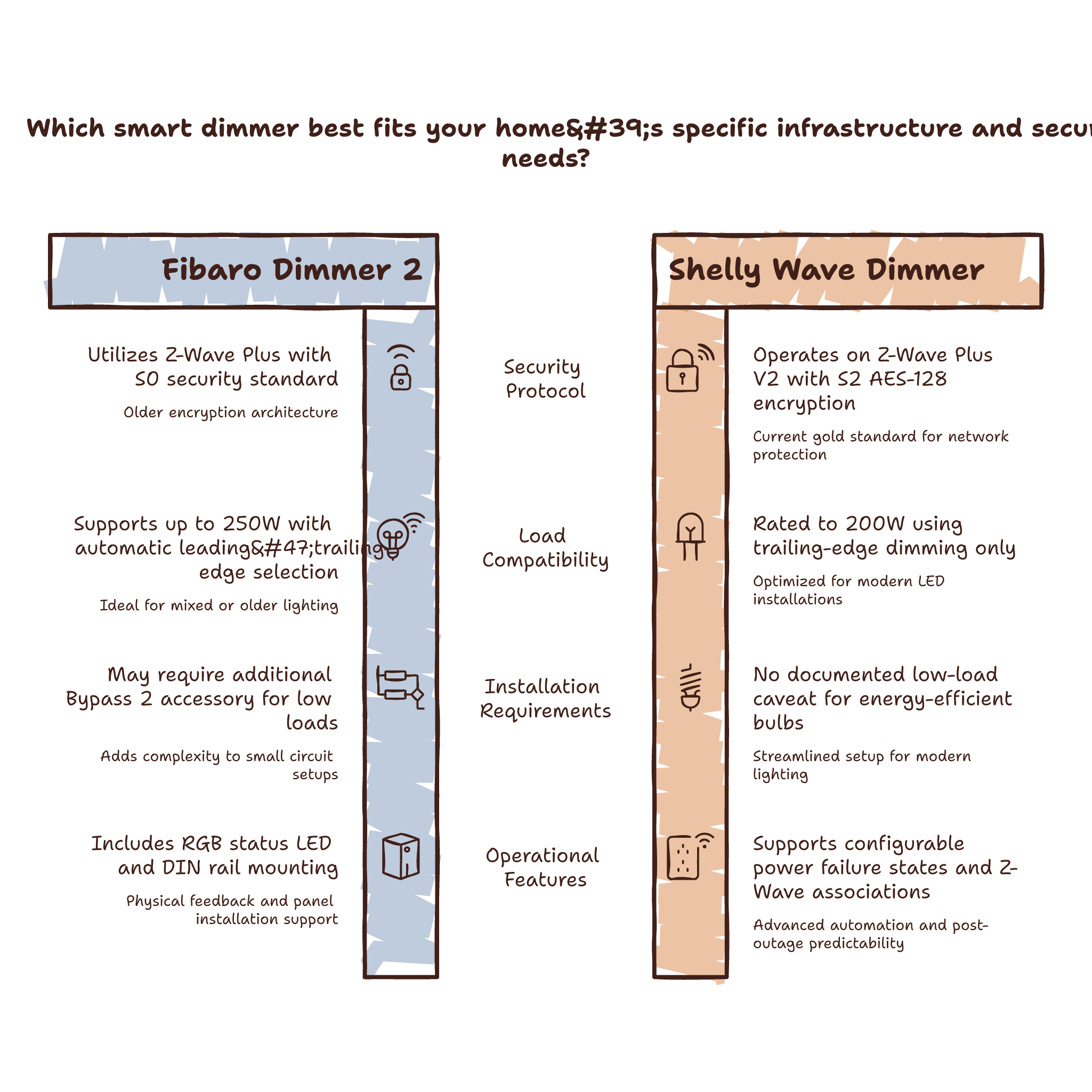
The Fibaro Universal Dimmer 2 runs on Z-Wave Plus with S0 security, while the Shelly Wave Dimmer operates on Z-Wave Plus V2 with S2 AES-128 encryption. This is not a trivial distinction. S2 is the current gold standard in Z-Wave security — it significantly reduces the risk of network interception during device inclusion and ongoing communication. For anyone building a security-conscious smart home or investing in a future-proof setup, the Shelly's S2 credentials represent a meaningful upgrade over the Fibaro's S0 standard.
Load Capacity and Dimming Mode
- Fibaro supports up to 250W (resistive), 225VA (resistive-inductive), and 200VA (resistive-capacitive)
- Shelly Wave Dimmer is rated to 200W across its supported load types
- Fibaro automatically selects trailing-edge or leading-edge dimming based on bulb type
- Shelly uses trailing-edge dimming only, without automatic mode switching
This distinction matters most for installations involving 12V transformer-driven lighting systems, which require leading-edge dimming. The Fibaro handles these automatically; the Shelly does not support them. For homes running entirely on modern dimmable LEDs, this difference is largely irrelevant — trailing-edge dimming is the preferred method for LED loads — but for mixed or older lighting environments, the Fibaro's auto-calibration is a genuine practical advantage.
Bypass Requirement and Low-Load Compatibility
The Fibaro Dimmer 2 may require the Fibaro Bypass 2 accessory for loads below 50W, which adds a step to installation and a small additional cost. The Shelly Wave Dimmer does not carry this documented low-load caveat, making it more straightforward for circuits driving a small number of energy-efficient LED bulbs — a common scenario in modern homes.
Installation Conveniences and Behavioural Flexibility
- Fibaro includes an RGB status LED for real-time installation and calibration feedback
- Fibaro offers DIN rail mounting, useful for panel or cupboard-based installations
- Shelly supports a configurable power failure state for predictable post-outage behaviour
- Shelly reacts to Z-Wave notifications and supports Z-Wave associations for richer automation
- Shelly operates from -20°C to 40°C, covering environments where Fibaro's tolerance may not be specified
Both devices support two-wire no-neutral wiring and two switch inputs, and both offer power monitoring functionality. The right choice between them depends less on headline features and more on the specific demands of your installation environment, your security expectations, and your smart home ecosystem.
Real-World Dimming Performance: Responsiveness, Reliability, and Smart Home Integration Compared
Specification comparisons are useful, but they only tell part of the story. In everyday use, dimming smoothness and reliability are what actually matter — and this is where the two modules begin to diverge in character. The Fibaro's auto-calibration algorithm actively adapts to the connected bulb type, which tends to reduce flickering across different lamp types and deliver more consistent results in mixed lighting environments. For homes where the same hub controls incandescent pendants in a dining room and LED downlights in a kitchen, that intelligence adds real comfort. The Shelly Wave Dimmer's trailing-edge approach is equally reliable in its own right, particularly with modern smart dimmable LED loads where trailing-edge is the natural fit — it simply does not actively switch between modes.
Mesh Network Behaviour and Hub Compatibility
Z-Wave Plus V2, as used by the Shelly Wave Dimmer, brings improvements to mesh network efficiency and signal robustness compared to the earlier Z-Wave Plus standard used by the Fibaro. In larger homes or properties with dense walls, this can translate to a more dependable mesh. The Fibaro Dimmer 2 compensates with an exceptionally broad list of confirmed compatible hubs — including Athom Homey, Fibaro HC2, HC3, HC3L and HCL, Homeseer, Hubitat, Samsung SmartThings, Vera, and Ezlo. For users already invested in one of these platforms, that explicit compatibility record is reassuring. The Shelly Wave Dimmer is compatible with modern Z-Wave Plus V2-capable hubs, though its named integrations are fewer in documented form.
Automation and Daily Interaction
- Fibaro's physical switch scene activation enables lighting scenes without a smartphone or app
- Shelly's Z-Wave notification reactions allow event-driven automation logic from across the network
- Both devices support power monitoring, enabling energy tracking through compatible hubs
For home assistant dimmer automation enthusiasts, the Shelly's ability to react to Z-Wave notifications opens up genuinely useful event-driven scenarios — lights responding to a door sensor, a motion trigger, or another device's state change. The Fibaro's scene activation via physical switch input, on the other hand, is a practical daily convenience that does not rely on hub availability at all.
Fibaro Dimmer 2: The Strengths and Trade-Offs You Should Know Before Buying
The Fibaro Universal Dimmer 2 has earned its reputation as one of the most capable retrofit dimmer modules available for Z-Wave smart home setups. Its automatic selection between trailing-edge and leading-edge dimming makes it genuinely universal across bulb types — incandescent, 230V halogen, 12V halogen, and dimmable LEDs are all supported without manual intervention. Add to that a confirmed compatibility list spanning over twenty named controllers and hubs, support for both 2-wire and 3-wire installations, built-in power metering, scene activation through physical switch inputs, DIN rail mounting, and OTA firmware upgrading, and it is easy to see why it remains a popular choice for both DIY enthusiasts and professional installers.
Where the Fibaro Has Limitations
- S0 security is less robust than the current S2 standard used by newer Z-Wave devices
- Loads below 50W may require the Fibaro Bypass 2 accessory, adding installation steps
- Configuration parameters can feel involved for users who prefer a simpler setup experience
The S0 security standard, while functional, does not offer the same level of network protection as the S2 encryption found in the Shelly Wave Dimmer. For users focused on building a security-hardened smart home, this is worth weighing carefully. Similarly, the bypass requirement for sub-50W loads — common with small LED circuits — introduces an extra consideration that some installations will need to plan for. The Fibaro Dimmer 2 rewards technical users who take time to understand its configuration options, but those looking for a plug-and-play experience may find it slightly more demanding than expected.
Shelly Wave Dimmer: What It Gets Right and Where It Falls Short
The Shelly Wave Dimmer brings a modern sensibility to the retrofit smart dimmer category. Its most significant strength is its Z-Wave Plus V2 certification paired with S2 AES-128 encryption — the most up-to-date Z-Wave security standard available, and a compelling reason to choose it for any new smart home build where long-term security matters. Ultra-low standby consumption of below 0.3W means that across a home with multiple modules installed, the cumulative energy overhead is minimal. Its wide operating temperature range of -20°C to 40°C makes it one of the few smart dimmable modules genuinely suited to garages, outbuildings, or poorly insulated utility rooms without compromise.
Additional Strengths Worth Noting
- Two switch inputs for flexible multi-switch wiring configurations
- Built-in overheat, overcurrent, and overvoltage protection for installation safety
- Configurable power failure state ensures predictable lighting behaviour after outages
- Native Z-Wave association and notification support for sophisticated automation logic
Where the Shelly Wave Dimmer shows limitations is in its 200W maximum load rating — lower than the Fibaro's 250W resistive ceiling — and its trailing-edge-only dimming approach. For installations involving transformer-based or resistive-inductive loads that benefit from leading-edge dimming, the Shelly is not equipped to adapt. Its documented hub integrations are also less extensive than the Fibaro's, which may give pause to users on less common platforms. That said, for modern LED-focused setups on current Z-Wave hubs, these limitations rarely come into play.
Choosing the Right Dimmer for Your Setup: Who Should Pick the Fibaro and Who Should Choose the Shelly
Both of these modules are capable devices, but they suit different types of installers and different smart home priorities. Understanding which profile matches your situation will make the choice straightforward.
Choose the Fibaro Universal Dimmer 2 If:
- You are already invested in the Fibaro ecosystem (HC2, HC3, HC3L, HCL) and want seamless native integration
- Your home has mixed bulb types — incandescent, halogen, 12V transformer-driven, and dimmable LEDs — and you want automatic dimming mode selection without manual configuration
- You are an installer or integrator who values DIN rail mounting, large connecting terminals, and in-device diagnostics via the RGB LED
- Your electrical system uses 2-wire no-neutral wiring with resistive-inductive transformer loads requiring leading-edge dimming support
- You are managing lighting loads up to 250W and need that additional headroom
The Fibaro's auto-calibration intelligence is its defining advantage. For a home where the lighting environment is varied or unpredictable, or where a professional installer needs reliable diagnostics during commissioning, it remains a highly practical choice. Its broad hub compatibility also makes it a safe bet for users who may switch controllers in the future.
Choose the Shelly Wave Dimmer If:
- You are building a modern smart home and want the best available Z-Wave security through S2 AES-128 encryption
- Energy efficiency matters at scale — sub-0.3W standby consumption adds up favourably across multiple devices
- You are installing in environments with temperature extremes such as garages, outbuildings, or utility rooms
- You want to leverage Z-Wave associations and Z-Wave notification reactions for event-driven home assistant dimmer automation
- Your lighting is predominantly modern dimmable LED, and you prefer a streamlined setup without complex bulb-type configuration
The Shelly Wave Dimmer is particularly well matched to users who think about their smart home as a long-term platform. Z-Wave Plus V2 with S2 encryption is not just a current advantage — it is a foundation that will remain relevant as smart home security standards continue to evolve. For automation enthusiasts who want their dimmer with no neutral wire to actively participate in wider home logic through Z-Wave notifications and associations, it delivers that capability natively and cleanly.
Fibaro Dimmer 2 vs Shelly Wave Dimmer: Making the Smart Choice for Your Home
Both the Fibaro Universal Dimmer 2 and the Shelly Wave Dimmer are well-engineered Z-Wave dimmer modules that retrofit into existing installations without major rewiring, support 2-wire and 3-wire systems, and include power metering functionality. For most homeowners, either device will deliver reliable smart dimmable lighting control from day one. The difference lies in the details — and those details point clearly towards different users.
The Core Distinction
- Fibaro excels at automatic dimming mode selection, broad bulb-type compatibility, and extensive hub ecosystem support
- Shelly leads on Z-Wave Plus V2 security, ultra-low standby power, temperature resilience, and home assistant dimmer automation flexibility
- Both support a dimmer with no neutral wire and offer power monitoring for energy awareness
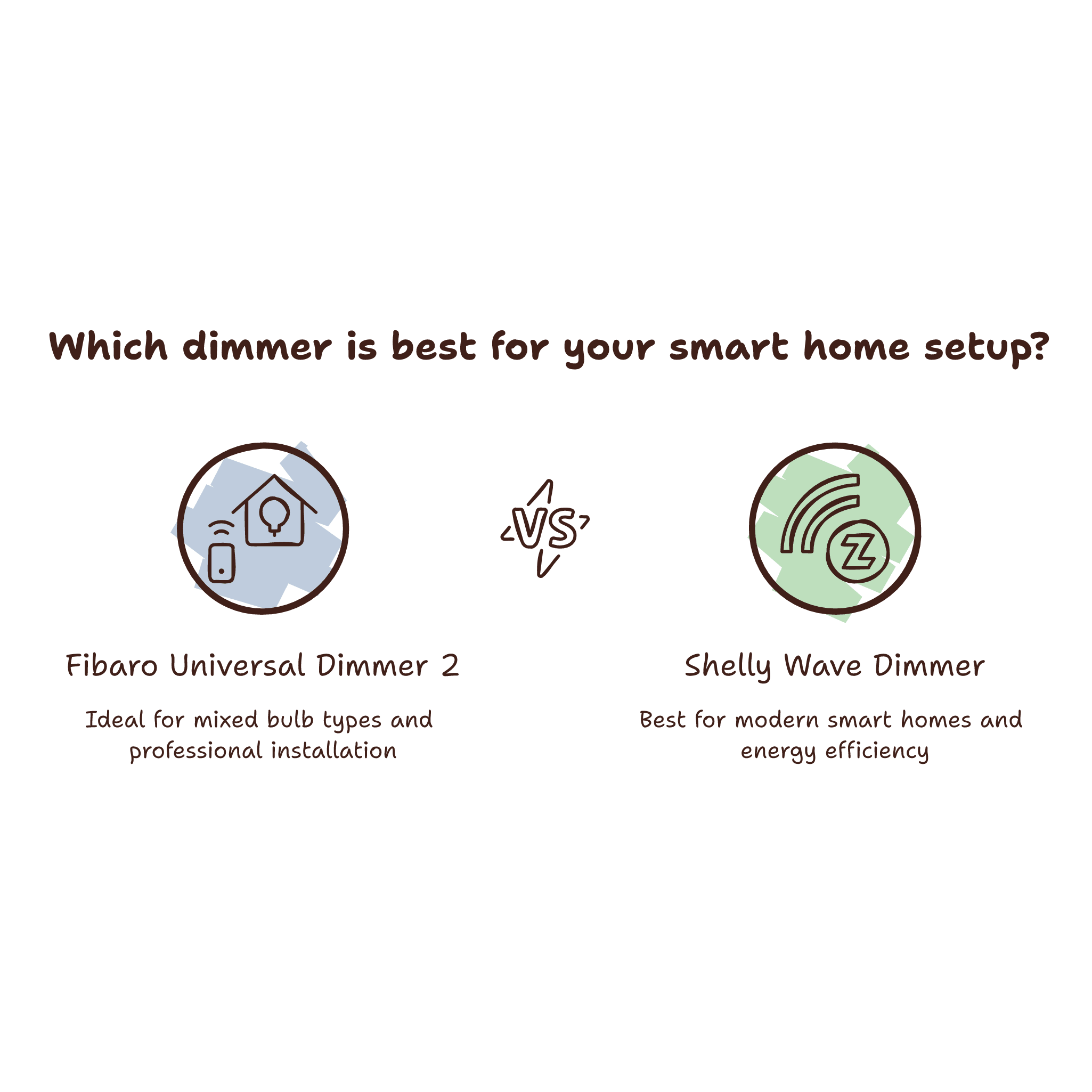
If your priority is handling mixed or legacy lighting environments with confidence, or if you are deeply embedded in the Fibaro ecosystem, the Fibaro Dimmer 2 is the stronger fit. If you are building a future-ready smart home where security, energy efficiency, and automation intelligence take precedence, the Shelly Wave Dimmer earns its place at the top of the shortlist. Take time to consider which features matter most to your setup — bulb compatibility, security standard, hub integration, or automation depth — and let that guide your decision.
Which Smart Dimmer Module Should You Choose?
If your priority is broad bulb-type compatibility, automatic dimming mode selection between trailing-edge and leading-edge, or deep integration within an established Fibaro or multi-hub ecosystem, the Fibaro Universal Dimmer 2 is the stronger fit. Its auto-calibration intelligence, DIN rail option, and support for higher resistive loads make it a compelling choice for complex or mixed lighting environments.
If you are building a modern smart home with a focus on network security, energy efficiency, and future-proof Z-Wave Plus V2 performance, the Shelly Wave Dimmer is the smarter long-term investment. Its S2 AES-128 encryption, ultra-low standby consumption, wide operating temperature range, and native Z-Wave notification and association support make it particularly well-suited to security-conscious users and automation enthusiasts.
Ultimately, both devices are excellent retrofit dimmer modules — the right one depends on your existing setup, your hub of choice, and the smart home behaviours you value most. Explore both the Fibaro Universal Dimmer 2 and the Shelly Wave Dimmer on Vesternet to compare their full specifications and find the perfect match for your home.