UK homes face a growing threat from opportunistic break-ins, and for many homeowners, the response has been to bolt on basic alarms, fit a deadlock, or install a standalone CCTV camera that records to a local hard drive. The problem is that these disconnected, single-layer systems leave critical gaps. Unmonitored entry points go undetected. Alerts arrive too late to prompt a meaningful response. Footage gets reviewed after the fact rather than triggering action in the moment. Traditional passive security was never designed to respond — it was designed to record, and that distinction matters enormously when your home is at risk.
The shift happening in residential security right now is significant. Smart home adoption in the UK is accelerating, and homeowners are demanding more than a system that simply logs what happened. They want automated home security systems that react intelligently — where smart home security cameras, door and window security sensors, motion detectors, access keypads, and sirens communicate with one another through Z-Wave, Zigbee, and Matter protocols to deliver a genuinely coordinated defence. The result is a move from reactive to proactive protection: real-time alerts, automated responses, remote arming and disarming, and visual plus acoustic deterrents working together as a unified system.
This guide covers 11 essential components and considerations for building that kind of layered, protocol-driven security ecosystem. Whether you are starting from scratch or upgrading an existing setup, you will find the technical knowledge and buying criteria needed to make confident decisions — from intelligent video surveillance and perimeter sensing through to access control, acoustic deterrents, and deep smart home integration.
1. Choose a Camera System That Goes Beyond Basic Recording
Modern automated home security systems demand more from their cameras than passive video capture. Today's smart home security cameras function as active intelligence hubs — analysing what they see, triggering responses, and in some cases managing other connected devices across your property. When evaluating cameras, the feature set that separates a capable security camera from a basic recorder is substantial.
Key features to look for in a security camera:
- AI-powered detection that distinguishes between people, animals, and vehicles
- Full-colour night vision for reliable low-light identification
- Dual-band Wi-Fi for stable, interference-resistant connectivity
- Local storage options alongside cloud — for resilience and data privacy
Some cameras now double as smart home hubs, supporting Zigbee, Matter, or Thread protocols directly. This compounding value — a single device that handles surveillance and device management — significantly reduces infrastructure complexity. Buyers should also evaluate IP ratings for weather resistance, operating temperature ranges for outdoor placement, and end-to-end encryption standards to protect both their footage and their network.
2. Evaluate Wireless Protocol Compatibility Across Your Entire System
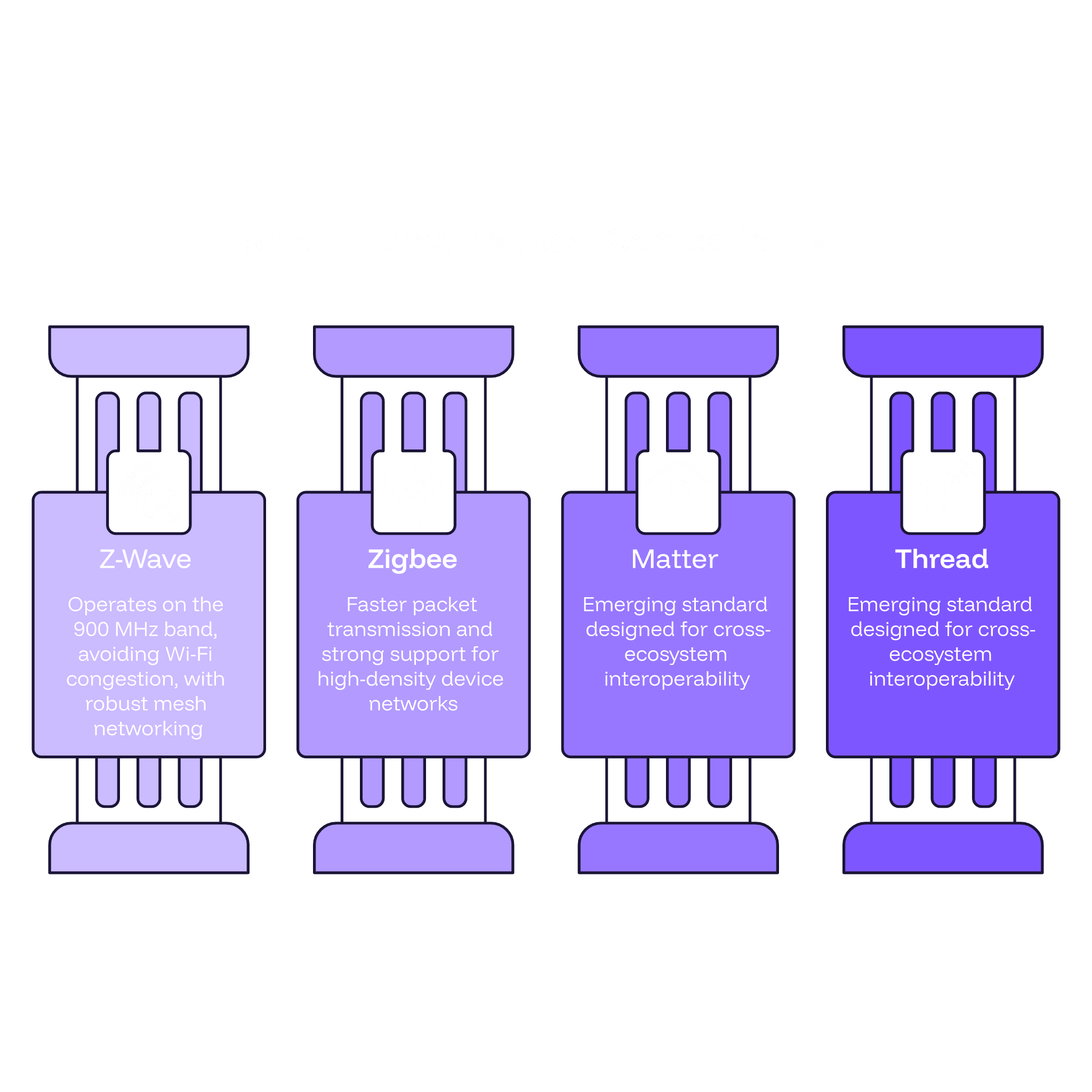
No component decision matters more to long-term system success than the wireless protocols underpinning your setup. Z-Wave, Zigbee, Matter, and Thread each have distinct characteristics, and choosing devices without mapping them against your hub's supported protocols is one of the most common and costly mistakes in smart home security builds.
Understanding the key protocols:
- Z-Wave: operates on the 900 MHz band, avoiding Wi-Fi congestion, with robust mesh networking
- Zigbee: faster packet transmission and strong support for high-density device networks
- Matter and Thread: emerging standards designed for cross-ecosystem interoperability
Mixed-protocol systems are entirely workable, but they require careful bridging. Some devices — particularly camera hubs — now act as multi-protocol controllers, supporting Zigbee, Matter, and Thread simultaneously and reducing the need for separate bridges. Before purchasing any security component, confirm which protocols your hub supports and map each new device to that ecosystem accordingly.
3. Assess Door and Window Sensor Detection Accuracy and Range
Doors and windows represent the most common intrusion entry points in UK residential properties, which makes door and window security your first and most critical physical line of defence. The quality of perimeter monitoring comes down to both detection accuracy and reliable wireless range — two factors that vary significantly across the sensor market.
What to assess in a door and window sensor:
- Multi-state detection: open, closed, and tilt positions for comprehensive monitoring
- Z-Wave Long Range support for reliable indoor coverage in larger or multi-floor properties
- Flexible mounting options: adhesive for rented properties, screw-fixing for permanent installs
- Battery life and supplementary sensing such as temperature or humidity monitoring
Tilt detection is particularly valuable because it allows sensors to identify a window left slightly ajar — a state a basic open/close sensor would miss entirely. For larger homes or those with thick walls and multiple floors, Z-Wave Long Range dramatically extends the reliable coverage area compared to standard protocols, ensuring no sensor is left operating at the edge of its range.
4. Factor in Outdoor Motion Detection Sensitivity and Environmental Tolerance
Outdoor motion sensors extend your automated home security system beyond the building envelope, reaching driveways, gardens, pathways, and outbuildings. They provide the earliest possible warning of an approaching threat — triggering responses before anyone reaches a door or window. To function reliably outdoors, however, these sensors must meet a significantly higher technical bar than their indoor counterparts.
Critical specifications for outdoor motion sensors:
- Adjustable PIR sensitivity thresholds to reduce false triggers from wildlife or foliage
- Built-in lux monitoring to enable context-aware automations, such as triggering lights only after dark
- Weather-resistance ratings and wide operating temperature tolerances as baseline requirements
- Power flexibility: battery operation for placement freedom, or low-voltage hardwired supply for continuous operation
Customisable motion-clear times are a frequently overlooked but valuable feature, determining how long after motion stops the sensor returns to a ready state. Getting these parameters right makes the difference between a sensor that floods you with repeated alerts and one that delivers clean, actionable notifications when they matter.
5. Understand How Access Control Keypads Strengthen Entry Point Security
Physical keys are a fundamental vulnerability in home security — they can be lost, copied, or handed on without authorisation. Smart keypads address this directly by replacing keys with programmable PIN codes and RFID tag access, giving you granular control over who can enter your property and when. For landlords, families with regular visitors, or homeowners who need to manage contractor access, this level of control is genuinely transformative.
A well-specified keypad goes well beyond simple code entry. Look for the ability to create time-limited access codes for guests or tradespeople, alongside a full audit trail of entry events for accountability. Tamper detection is a non-negotiable feature — if the keypad is physically interfered with or forcibly removed, the system should trigger an immediate alert. Many keypads also serve a dual function, acting as the interface for arming and disarming your wider alarm system directly at the door.
Features that add practical value in a smart keypad:
- Proximity-activated backlighting for safe, visible use at night
- RFID tag support alongside PIN codes for flexible access management
- Indoor and outdoor mounting compatibility with adhesive and screw-fixing options
- Tri-colour status indicators for clear system state feedback
6. Consider Acoustic Deterrent Power and Alert Versatility
A high-decibel siren is one of the most psychologically effective deterrents in any security system. Sound output directly correlates with deterrent effectiveness — a loud, unexpected alarm triggers an immediate flight response in most would-be intruders and draws attention from neighbours. But a quality siren offers considerably more than raw volume.
What to evaluate in a smart siren:
- Maximum dB output and configurable volume levels for different environments
- Multiple selectable alarm tones for different alert types and scenarios
- Visual strobe capability for dual sensory deterrence
- Backup battery performance to maintain operation during a power outage
The most versatile sirens extend beyond burglar alarms entirely — integrating with smoke, carbon monoxide, and leak detectors to serve as a multi-role safety notification speaker across the home. This expands the value of the investment beyond security. Installation simplicity matters too: plug-in units are far easier to deploy than hardwired alternatives, while optional wall or ceiling mounting keeps the device out of reach.
7. Prioritise S2 Security Encryption and Tamper Protection
The wireless security of your smart home devices is just as important as their physical function — particularly in a security context where a compromised device could theoretically be used to disable the very system protecting your home. This is not a theoretical concern; unsecured smart home devices have been exploited in real-world scenarios, which is why encryption and tamper protection must be treated as baseline requirements rather than optional extras.
S2 encryption is the gold standard for Z-Wave devices. It uses AES-128 encryption combined with multi-layer authentication to prevent eavesdropping, replay attacks, and device spoofing — the three most common wireless attack vectors. Alongside encryption, physical tamper detection at the hardware level adds another layer of protection, triggering instant alerts if a sensor, keypad, or siren is physically disturbed.
Security features to confirm before purchasing:
- S2 encryption with AES-128 as standard across all Z-Wave security devices
- SmartStart provisioning via QR code for secure, streamlined pairing
- Hardware-level tamper detection on sensors and keypads
8. Plan for Layered Coverage: Combining Perimeter, Interior, and Access Monitoring
Evaluating individual components is only part of the process. The greater design challenge — and the greater opportunity — lies in how those components are stacked into a cohesive, layered security architecture. A well-designed system uses multiple sensor types working in concert, each covering different zones and scenarios that the others cannot address alone.
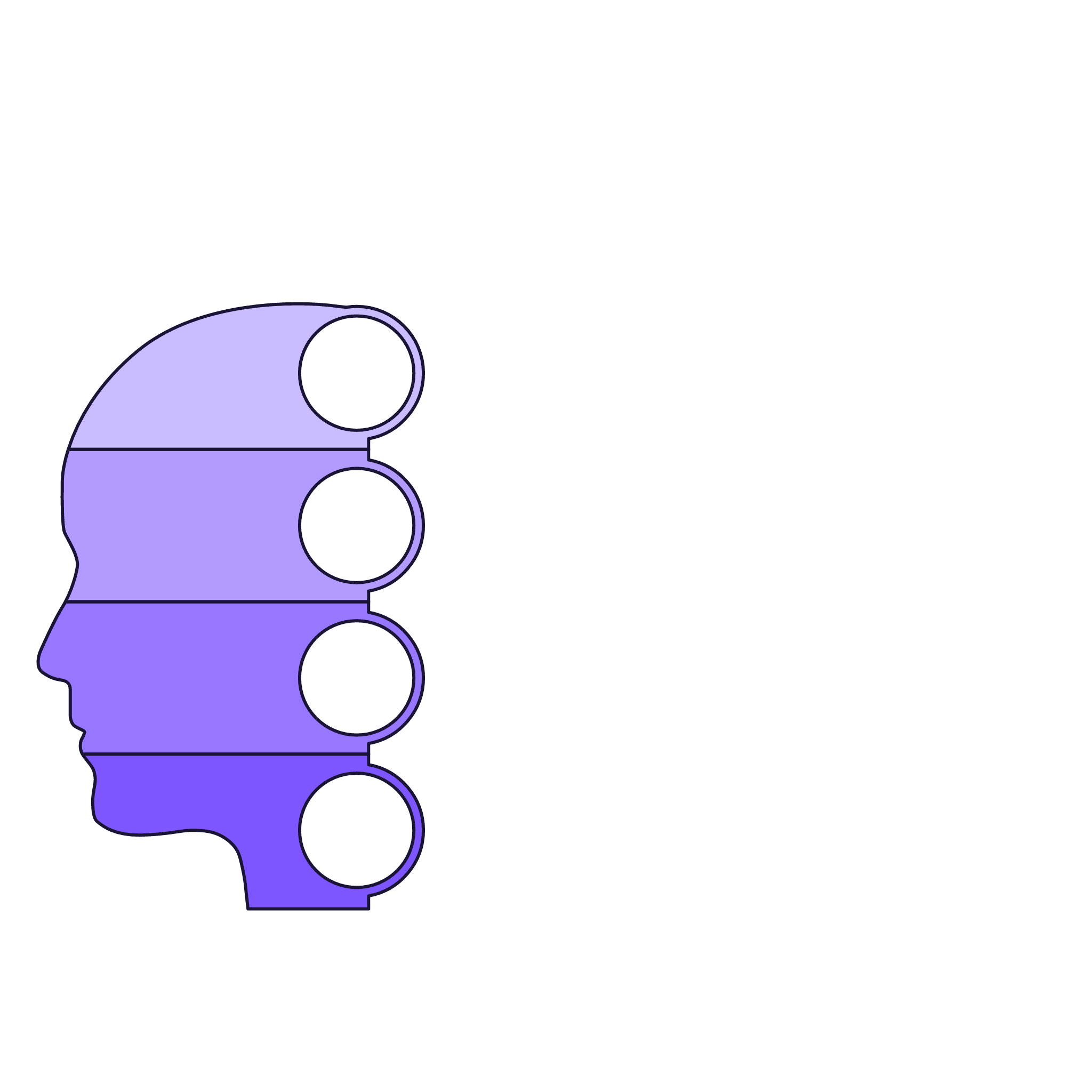
The three-tier security model:
- Perimeter detection: outdoor motion sensors and door and window security sensors as the outermost layer
- Access control: smart keypads and connected locks managing authorised entry points
- Interior monitoring: smart home security cameras and indoor motion sensors for visual verification
Automation logic is what ties these layers together into something greater than the sum of their parts. For example: a door sensor trigger initiates a keypad countdown, and if no valid code is entered within the time window, the siren activates and the camera begins motion-activated recording. This kind of automated response sequence transforms a collection of devices into a genuinely intelligent automated home security system.
9. Evaluate Real-Time Alerting, Remote Monitoring, and Notification Reliability
The practical value of any security system depends significantly on how quickly and reliably it gets information to you — and how effectively you can respond remotely. Push notification speed, remote arming and disarming capability, live video streaming quality, and two-way audio for on-the-spot deterrence are all features worth scrutinising carefully before committing to a platform.
Remote monitoring capabilities to assess:
- Push notification speed and consistency across different network conditions
- Live video streaming quality and latency during remote access
- Two-way audio for real-time communication or verbal deterrence
- Notification customisation to reduce alert fatigue from low-priority events
Hub-based local processing is worth prioritising over fully cloud-dependent architectures. Systems that rely entirely on cloud connectivity lose functionality during internet outages — a significant vulnerability in a security context. Local processing reduces latency and ensures your automated home security system continues to respond to events even when your broadband connection goes down.
10. Account for Installation Complexity, Power Options, and Future Scalability
The practical realities of installation have a significant bearing on both the upfront effort and the long-term reliability of your security setup. Power source is one of the first decisions to make for each device — battery-powered units offer complete placement flexibility with no wiring required, while mains-powered devices provide continuous operation with backup battery as the failsafe. Neither option is universally superior; the right choice depends on the specific location and use case.
Wireless range planning is equally important, particularly for larger or multi-storey properties. Z-Wave's mesh networking architecture allows devices to relay signals across the network, so increasing device density — adding more sensors — actually improves overall system range and reliability. This makes incremental expansion not just financially sensible but technically beneficial.
Scalability considerations when choosing your ecosystem:
- Hub capacity for future device additions without full reconfiguration
- Protocol flexibility to accommodate both Z-Wave and Zigbee devices over time
- Mesh network resilience that improves as the system grows
11. Assess Smart Home Integration Depth and Automation Potential
The final evaluation dimension is arguably the most important: how deeply does each security component integrate into your broader smart home, and what automation scenarios does that integration unlock? Compatibility with Apple HomeKit, Amazon Alexa, Google Home, and Home Assistant varies widely between devices and manufacturers, and Matter's cross-ecosystem promise is making this landscape more accessible than ever.
Security-specific automation use cases illustrate the transformative potential of deep integration. Motion-activated recording on camera trigger, automatic exterior lighting when an outdoor sensor detects movement, siren activation on forced entry detection, or a full emergency mode that simultaneously locks all connected points, activates all sirens, and dispatches alerts — none of these are possible with standalone devices. The highest value in smart home security comes not from individual device capability, but from seamless, intelligent inter-device automation.
Integration scenarios worth planning for:
- Motion trigger activates recording on connected smart home security cameras
- Door and window security sensor triggers exterior lighting and keypad countdown
- Emergency mode: all sirens activate, all connected locks engage, alerts sent simultaneously
- Away mode: system arms automatically when last resident leaves, based on presence detection
Our Recommended Smart Home Security Components
Building a comprehensive automated security system means selecting components that not only perform their individual roles with precision but also communicate seamlessly as part of a unified, protocol-driven ecosystem. The following products represent carefully selected options across key security categories available at Vesternet, chosen for their technical capability, integration depth, and real-world reliability.
Best for Intelligent Video Surveillance and Multi-Protocol Hub Integration — Aqara Camera Hub G5 Pro
For users who want their security camera to do more than record footage, the Aqara Camera Hub G5 Pro is an outstanding centrepiece for a modern smart home security system. It combines full-colour night vision, AI-powered detection, dual-band Wi-Fi with WPA3 encryption, and a built-in 100 dB siren into a single IP65-rated, weatherproof device. Critically, it also functions as a Zigbee hub, Matter controller, and Thread router — meaning it can directly manage other Zigbee sensors and devices without a separate bridge.
With onboard local storage, HomeKit Secure Video support, NAS compatibility, and RTSP streaming, it offers premium-tier data control and integration flexibility for users who take data privacy seriously. Positioned at the higher end of the investment scale, it delivers exceptional value for those building a full ecosystem around a single capable device.
Best for Perimeter Door and Window Monitoring — Aeotec Door Window Sensor 8
Designed for homes of all sizes, the Aeotec Door Window Sensor 8 is a high-performance Z-Wave 800 Series sensor that monitors open, closed, and tilt states across doors and windows. Its headline feature is Z-Wave Long Range, delivering reliable indoor coverage vastly beyond standard smart home protocols — making it particularly well suited to larger properties or challenging building layouts where signal reliability is a genuine concern.
What makes it stand out for door and window security:
- Multi-state detection: open, closed, and tilt for comprehensive perimeter monitoring
- Z-Wave Long Range for extended, reliable indoor coverage
- Temperature and humidity monitoring adds environmental sensing value
- S2 encryption and SmartStart QR pairing for secure, straightforward setup
Best for Outdoor Perimeter Motion Detection — Zooz Z-Wave Outdoor Motion Sensor
Purpose-built for outdoor deployment, this Zooz sensor provides reliable, weather-resistant motion detection with built-in ambient light monitoring for intelligent, context-aware automations. Its ability to trigger smart home security cameras, lights, alarms, or even sprinkler systems on motion makes it highly versatile for both security and convenience use cases. Advanced parameter configuration — adjustable lux thresholds, sensitivity levels, and motion-clear times — allows experienced users to fine-tune performance precisely to their environment.
Power flexibility via battery or low-voltage hardwired supply, S2 security, and SmartStart support make it a practical and competitively positioned addition to any outdoor security perimeter. It is a strong mid-range choice for homeowners who want capable outdoor sensing without unnecessary complexity.
Best for Access Control and Alarm Management — Frient Keypad
The Frient Keypad delivers professional-grade access control for both residential and light commercial environments. Supporting PIN code and RFID tag entry, it enables granular, traceable access management — ideal for homes with multiple residents, frequent guests, or property managers who need reliable contractor access logs without handing over physical keys. Its dual function as both an access controller and alarm system interface means it can arm and disarm a connected security system directly at the front door, streamlining the daily user experience considerably.
Practical features that add real-world value:
- Built-in tamper detection with immediate system alert on interference
- Proximity-activated backlighting for reliable night-time use
- Tri-colour LED status indicators for clear, at-a-glance system feedback
- Mountable via screws or adhesive tape for indoor and outdoor installation
Best for High-Decibel Acoustic Deterrence — Aeotec Siren 6
The Aeotec Siren 6 is one of the most capable Z-Wave indoor sirens available, combining a 105 dB speaker with configurable volume levels, 15 selectable alarm tones, and a high-output strobe LED array for dual sensory deterrence. Its value extends well beyond burglar alarms — it integrates with Z-Wave smoke, CO, and leak detectors as an additional notification speaker, making it a genuinely multi-role safety investment rather than a single-purpose device.
A built-in, continuously recharging backup battery ensures continued operation during power outages — a critical feature for any resilient automated home security system. Three layers of Z-Wave Plus S2 wireless security protect it from signal interference, and its plug-in setup with optional wall or ceiling mounting makes installation accessible without specialist help. It is an excellent choice for users who want professional siren capability without professional installation costs.
Conclusion
Building a truly comprehensive automated home security system is no longer the exclusive domain of professional installers or commercial properties. The right combination of intelligent smart home security cameras, door and window security sensors, outdoor motion detectors, access keypads, and high-decibel sirens — connected through robust protocols like Z-Wave, Zigbee, and Matter — can deliver layered, proactive protection that reacts intelligently to threats in real time. The key takeaway is that security value multiplies with integration: individual devices are useful, but a coordinated ecosystem that shares data and triggers automated responses is genuinely transformative.
The practical next steps are straightforward. Start by auditing the vulnerable entry points in your property — front door, back door, ground-floor windows, driveway — and identify which protocol ecosystem aligns with your existing or planned hub. Build outward from a reliable centrepiece device, prioritising S2-encrypted Z-Wave or Zigbee components for your security layer, and ensure your camera solution supports local storage for resilience during outages. Use automation logic to tie your sensors, siren, and access control into cohesive response sequences. Small, incremental builds starting with perimeter sensors and a siren, then adding cameras and keypads over time, are entirely valid and allow budgets to be spread sensibly.
Vesternet stocks a carefully curated range of smart home security components across cameras, door and window sensors, and sirens — all from trusted brands proven in real smart home environments. If you are unsure where to start or which products best suit your specific setup, our team of smart home experts is always on hand to provide personalised guidance. Explore the full collections at Vesternet and take the first step towards a smarter, more secure home.