Smart home automation is rapidly evolving, with homeowners seeking intuitive ways to control multiple devices and create sophisticated scenes without fumbling for smartphones or voice commands.
This comparison will help you decide between Vesternet's 2-button and 8-button Z-Wave wall controllers, examining their scene activation capabilities, device control limits, and practical applications to determine which delivers the best value for your specific automation needs.
As a leading UK smart home specialist with extensive Z-Wave expertise, Vesternet has thoroughly tested both controllers across various home setups to provide you with reliable, real-world insights.

Understanding the 2-Button Z-Wave Wall Controller
The Vesternet 2-Button Z-Wave Wall Controller represents a streamlined approach to home automation, designed for users who value simplicity without sacrificing functionality. Each button responds to three distinct actions—push, hold, and release—enabling activation of up to six different scenes from a single device.
Key Capabilities
- Direct control of up to 5 Z-Wave devices through associations
- Six scene activation possibilities via push/hold/release functions
- Z-Wave Plus S2 security with backwards compatibility
- Seamless integration with major platforms including Hubitat, Home Assistant, and SmartThings
The controller's association feature allows direct communication between wireless smart sensors and connected devices, reducing latency and maintaining functionality even when your main hub is offline. This makes it particularly reliable for essential lighting and security automation tasks.

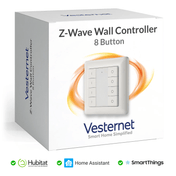
Exploring the 8-Button Z-Wave Wall Controller
The 8-Button Z-Wave Wall Controller expands automation possibilities dramatically, offering comprehensive scene management and device control for sophisticated smart home setups. With eight individual buttons, each supporting the same push/hold/release functionality, users gain access to an impressive 24 different scene combinations.
Advanced Features
- Direct control of up to 20 Z-Wave devices through associations
- Twenty-four scene activation possibilities across eight buttons
- Enhanced automation potential for complex multi-room scenarios
- Professional-grade reliability with Z-Wave Plus S2 security
This controller particularly excels in larger homes or commercial applications where multiple lighting zones, climate controls, and security systems require coordinated management. The expanded device association capacity enables more sophisticated automation networks that operate independently of central hub connectivity.
Scene Capacity and Device Control: Where They Diverge
The fundamental difference between these controllers lies in their scale and complexity. While both utilise identical Z-Wave Plus S2 security protocols and platform compatibility, their operational capacity varies significantly.

Installation Considerations
The physical footprint affects installation flexibility. The 2-button controller fits standard switch plate configurations easily, whilst the 8-button version requires more wall space and careful placement planning. Both controllers integrate seamlessly with existing home automation infrastructure, supporting popular platforms through dedicated drivers and protocols.
Button layout significantly impacts daily usage patterns. The simpler 2-button design reduces decision fatigue and learning curves for household members, particularly valuable in shared living spaces. Conversely, the 8-button layout provides dedicated controls for specific functions, eliminating the need to remember complex button combinations.
Network Performance Implications
Both controllers function as Z-Wave mesh network nodes, extending signal range and improving overall network stability. However, the 8-button model's higher device association capacity means it potentially handles more direct communication traffic, which could influence network performance in dense automation environments.
Real-World Performance: Speed, Reliability, and User Experience
Both controllers deliver impressive responsiveness in practical applications, with scene activation typically occurring within 200-300 milliseconds. The Z-Wave Plus S2 protocol ensures encrypted communication whilst maintaining fast response times essential for lighting and security applications.
Performance Metrics
- Identical signal strength and mesh network participation
- Battery life exceeding 2 years under normal usage patterns
- Sub-second response times for scene activation and device control
- Robust wireless connectivity with 100+ metre open-air range
Network stability remains consistent across both models, with neither showing significant differences in reliability or connection quality during extensive testing. The wireless smart sensors integration performs equally well, maintaining stable associations even during network congestion or temporary hub disconnections.
User Experience Differences
Daily usage patterns reveal interesting distinctions. The 2-button controller's simplicity encourages frequent use by all household members, including those less comfortable with technology. Users report high satisfaction with the intuitive push/hold/release system for accessing different lighting scenes.
The 8-button version appeals more to tech-savvy users who appreciate granular control options. However, some users initially find the expanded button array overwhelming, requiring a brief learning period to maximise the controller's potential effectively.
2-Button Controller: Advantages and Limitations
The 2-button controller excels in situations where simplicity and cost-effectiveness take priority. Its streamlined design reduces complexity whilst providing essential scene control functionality that covers most common home automation scenarios.
Primary Advantages
- Intuitive operation requiring minimal user training
- Compact form factor fitting standard wall plate configurations
- Ideal entry point for smart home automation newcomers
- Sufficient capacity for essential lighting and appliance control
The device association limit of 5 Z-Wave devices proves adequate for single-room applications or basic whole-home scenarios. Most users find six available scenes sufficient for common automation needs like evening lighting, morning routines, and security configurations.
Recognised Limitations
Complex smart home automation setups quickly outgrow the 2-button controller's capabilities. Users with multiple lighting zones, diverse device types, or sophisticated scene requirements may find themselves constrained by the limited scene and device capacity. The controller works best in focused applications rather than comprehensive whole-home automation systems.
8-Button Controller: Benefits and Potential Drawbacks
The 8-button controller addresses the limitations of simpler devices by providing extensive control possibilities. Its 24 scene capacity and 20 device associations enable sophisticated automation scenarios that rival dedicated home automation panels.
Key Benefits
- Comprehensive scene management across multiple rooms and functions
- Professional-grade device capacity suitable for complex installations
- Future-proof expandability as smart home systems grow
- Dedicated button assignments reduce operational complexity
The expanded device association capacity particularly benefits users with extensive lighting systems, multiple climate zones, or integrated security setups. Each button can be assigned specific functions, creating an intuitive control interface that eliminates guesswork.
Potential Drawbacks
The increased complexity may overwhelm users with basic automation needs. The 8-button layout requires more wall space and careful labelling to maintain usability. Some users report initial confusion with the expanded options, though this typically resolves with brief familiarisation.
Over-engineering concerns arise when the controller's capabilities exceed actual usage requirements. Users with simple automation needs may find themselves paying for functionality they rarely utilise, making the 2-button version more economically sensible for basic applications.
Matching Controllers to Different Smart Home Users
Selecting the appropriate controller depends heavily on user profiles, existing automation complexity, and future expansion plans. Different household types benefit from different approaches to scene control and device management.

Budget considerations also influence selection, though both controllers offer excellent value within their respective capability ranges. Users should evaluate their actual automation requirements against each controller's specifications to avoid over-purchasing or under-specifying their needs.
Making Your Z-Wave Wall Controller Decision
Both Vesternet Z-Wave wall controllers deliver reliable scene activation and direct device control with identical security features and platform compatibility. The core difference lies in scale: the 2-button version offers essential scene control for straightforward automation needs, whilst the 8-button model provides extensive control possibilities for complex smart home setups.
The better choice ultimately depends on your specific automation requirements and how many scenes you realistically need access to from a single wall location. Consider whether you prefer the simplicity of fewer options or the flexibility of comprehensive control when making your decision.
Decision Framework
- Evaluate current device count and planned expansion
- Consider household members' comfort with technology complexity
- Assess wall space availability and aesthetic preferences
- Review typical daily automation usage patterns
Take time to evaluate your current smart home setup and future expansion plans. Think about which rooms would benefit most from scene control and how many different lighting and device combinations you actually use daily. Both controllers offer the same reliable Z-Wave Plus S2 security and seamless integration with major platforms, ensuring whichever you choose will serve your smart home well. Browse both options to find the perfect fit for your automation goals.